The first shirt I ruined was a white polyester performance tee for a Little League team, and the logo came off the press looking like it had spent a summer in a shop window. I did what anyone would do. I raised the temperature, pressed it longer, and ruined the second one worse. The press was fine. The heat was fine. What I did not understand yet was what sublimation ink actually does when it leaves the paper, and how much of the finished result depends on the fiber sitting underneath it. That was roughly three years ago. Since then I have printed team shirts, teacher tumblers, family reunion gear, holiday mugs and a slow but steady trickle of Etsy orders out of the spare bedroom of my house in Toms River, New Jersey, and I have formed firm opinions about which supplies earn their shelf space.
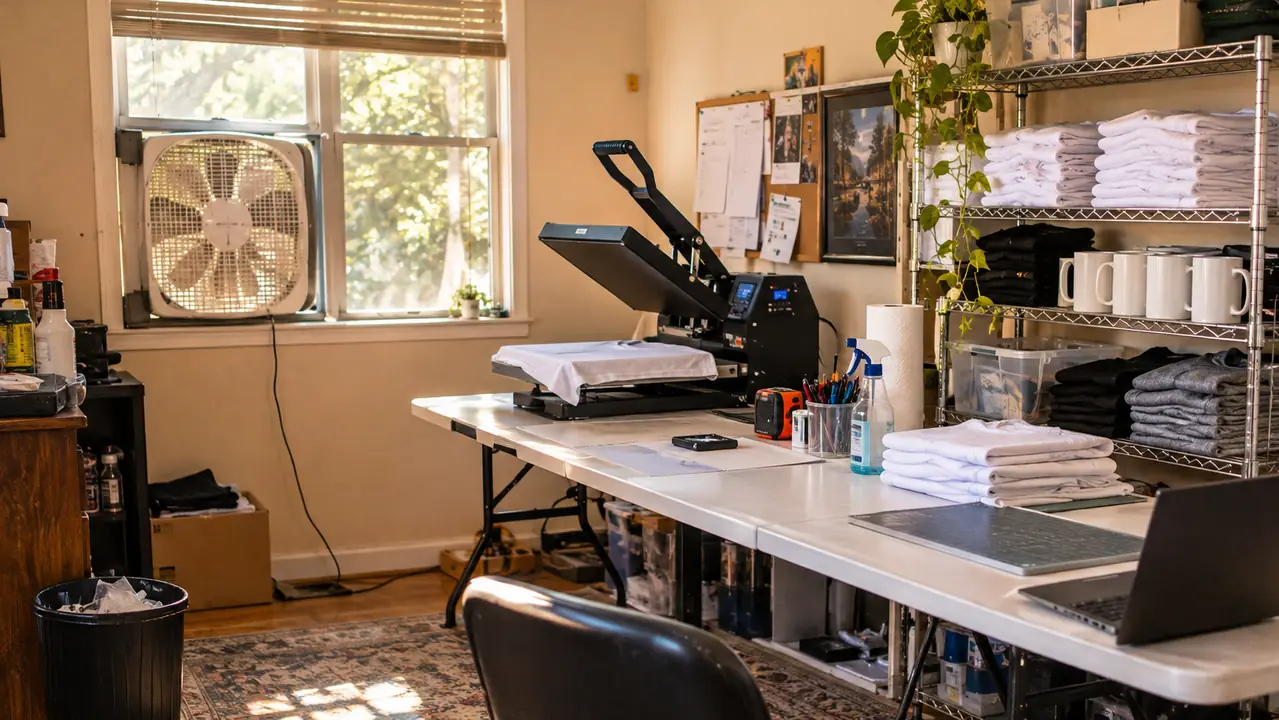
Hiipoo sublimation ink, the four-bottle refill set, has been running through the one Epson EcoTank ET-2800 in my back bedroom for most of the last three years. I am Carla Benedetti, fifty-four, a former school office manager, and the entire staff of this part-time operation. One long folding table. A wire shelf of blanks. A window fan that runs all summer because the press makes the room smell like a hot iron. My husband Sal is retired, folds and bags the orders, and serves as test wearer for anything I am unsure about. I started with family reunion shirts and now take work from neighbors, a local Little League, two teachers' groups and a small Etsy shop, evenings and Saturdays.
This is not going to be a review where every single thing is wonderful. The prints are good. The refilling is a nuisance. The color can drift if you stop paying attention. Here is the whole picture, in the order I actually ran into it.
The Quick Verdict
Steady, saturated color on polyester and coated blanks, and it matches itself across reorders, which is the thing that protects repeat business. The fiddly refill and the missing color profile are the honest tradeoffs.
Amazon Check Today's Price →The Four Bottles That Live on My Wire Shelf
One set covers all four ink channels, and the listing rates it at 7,500 pages. It is what runs through the printer on my table every Saturday.
Amazon Check Today's Price on Amazon →What Nobody Tells You First
Sublimation ink does not sit on top of anything. Under heat it turns to gas and bonds into polyester fiber, which is why a finished shirt has no raised texture where the print is and why the print will not crack or peel off in the wash. That is the entire appeal. It is also why the blank decides the outcome more than the ink does, and why I spent my first six months blaming the wrong part of the process.
So when a transfer comes out faint, the ink is close to the last thing I suspect. Paper matters more than people expect. A cheap sheet releases unevenly and the print comes out mottled or dim. Moisture is the other one. If a shirt has been sitting in a cold garage, the fiber is holding water, the water flashes to steam under the platen, and you get that washed-out, slightly ghosted look that everyone blames on their ink. Anything I care about gets pressed from blanks that sat in the house overnight. That one habit fixed more bad prints than any setting change I have ever made.
Ink quality does show up in the things a product photo cannot show you. Poor ink separates in the bottle and clogs a print head, and a clogged head on a converted EcoTank is a bad afternoon of nozzle checks and cleaning cycles. Poor ink also shifts between batches, so a reorder stops matching the shirts you sold in the spring and you find out in front of a customer. The reason I stayed with Hiipoo after the first set is boring and specific. The second set printed the same red on the same mug wrap as the first set had three months earlier, and I did not have to rebuild my notes.
None of that is persuasive if you are still choosing a printer, so let me say the other thing nobody tells you. The press matters less than you think at the start. I bought a modest press and a modest printer and put my money into good paper and decent blanks, and I would do it again in that order. A fancy press cannot rescue cheap paper, and a full set of expensive supplies cannot rescue a blank that has no polyester in it.
How I've Used It
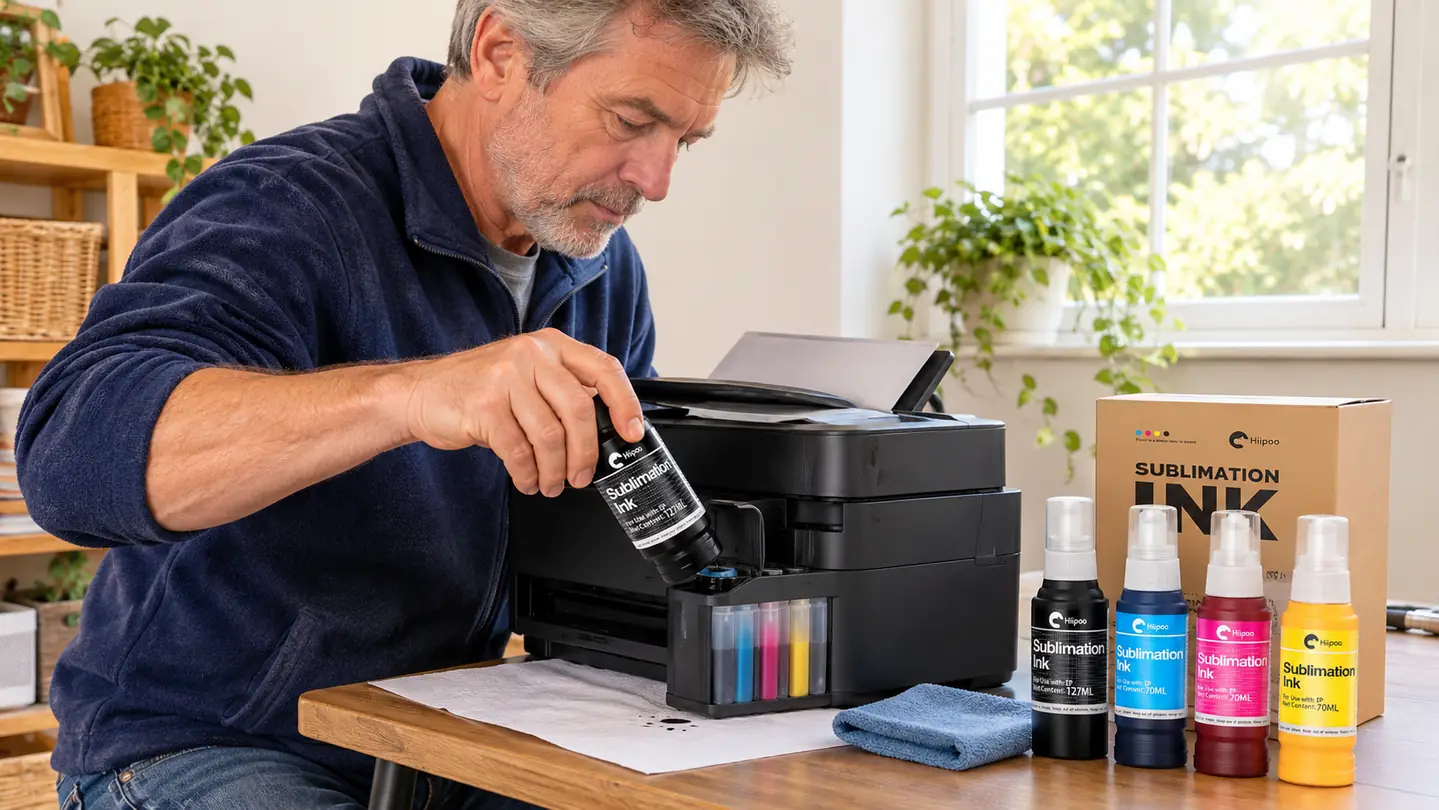
My printer is one Epson EcoTank ET-2800 and it has only ever had sublimation ink in it. I bought it for this and never installed the starter bottles that came in the box. That is the single most important habit in the whole setup, because a printer that has run regular ink needs a flush before sublimation will behave, and a flush is a long, wasteful, frustrating job that I would not wish on a person I like.
The set covers black, cyan, yellow and magenta, one bottle for each channel, and the listing puts the yield at 7,500 pages. It also lists a long compatibility run: the ET-2800 I use, plus the ET-2400, ET-2720, ET-2760 and ET-4800 among the EcoTank models, and the older Stylus C88 and C88+ on the cartridge side. I can only speak to the ET-2800 because that is the only machine on my table, and I would rather tell you that than pretend I have worked through the whole list.
Filling the tanks is the part that gets me. The bottles work fine, but they are bottles, and I am a person with a real talent for spilling things on a Tuesday. I put a folded paper towel under the printer, tip slowly, and stop at the fill line. Overfill once and the excess runs down the front of the machine and onto whatever you were foolish enough to leave on the table. I store the bottles upright in a shallow plastic tray on the shelf, because a bottle that tips over in a drawer is a story with no good ending.
After a refill I always print something I do not care about first. Two or three prints and the color settles. The first one off the line is usually a hair light, and if that first print is a teacher tumbler with a name on it, you have just made a present for nobody. Sal has a drawer of test shirts and I have a drawer of test mug wraps, and those two drawers have saved me more money than any other habit I keep.
What It Actually Prints Well
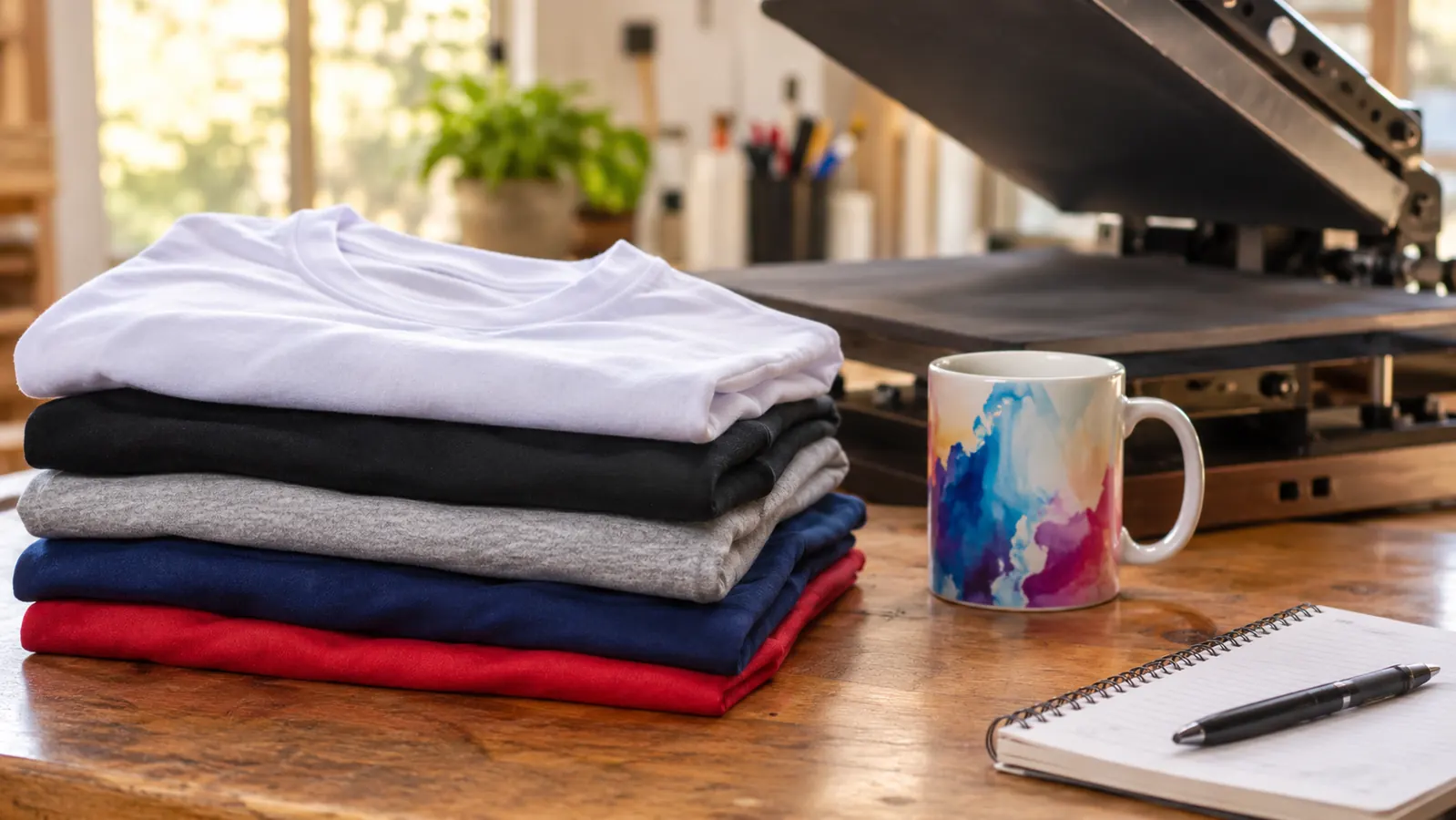
Mug wraps are where I noticed the difference first. A coated sublimation mug takes the transfer in about sixty seconds in a wrap press and the color comes out dense enough that people ask whether it is printed on. November and December are mostly mugs for me, and I have never had one come back for fading. The ones that have gone through my own dishwasher a few times a week look the same as the day I pressed them, and I say that as someone who keeps a box of failures for honesty's sake.
Performance tees are the other main event. Full polyester, pressed around 390 degrees for about sixty seconds at medium pressure. The print goes into the fabric and the shirt stays soft, which is the whole reason people pay for this process instead of vinyl. I have shirts from my first year that were worn every week through a Little League season, and the print has not cracked. That is the fiber and the heat and the time working together, not any one bottle. But the ink has to gas out cleanly and evenly, and cheap ink does not always do that.
Tote bags and tumblers sold as sublimation blanks are the third bucket. Those are coated, and they behave a lot like the mugs. Where it does not work is anything uncoated: a plain canvas tote, a cotton apron, a dark shirt of any fiber, a ceramic mug off a dollar shelf with no sublimation coating. I have tried all four of those and I have a small box of evidence to prove it.
One more thing worth knowing before you plan a season. The ink behaves differently depending on how much of the sheet you cover. A design with a white background and a small logo uses a fraction of what a full-bleed photo uses. That sounds obvious written down. It is not obvious when you are estimating how far a set will stretch, and it is the difference between finishing a job comfortably and making a phone call you do not want to make.
The Cotton Rule Will Bite You Eventually
The listing says it plainly: sublimation ink can only be used in fabrics containing less than 30% cotton. It is buried in the middle of a bullet point and it should be the first thing on the page, because it is the rule that turns a good afternoon into a sad one. I have watched people buy a lovely cotton canvas tote at a craft store, print it, and get a ghost of an image that fades further with every wash. The ink did nothing wrong. It had nowhere to bond.
What actually works is polyester, and mostly high polyester content at that. Performance tees, poly-rich blends, and coated blanks like the mug wraps and tumblers sold specifically for sublimation. The other half of the rule is that you cannot print white. There is no white in this set and there is no white in any set like it. The blank has to be lighter than the image you want to transfer, or the picture simply will not show up. I keep a cheap flashlight in the drawer and hold it under anything I am unsure about.
There is one workaround and it is not really a workaround. You can print onto a polyester transfer sheet and press that onto cotton, but at that point the sublimation ink is not doing the work, the sheet is. If cotton is most of what you sell, this is the wrong process for you, not the wrong bottle.
The Friday I Ran Out
I want to tell you about a specific bad Friday, because it is the most useful thing in this whole review. A summer team order came in, two dozen shirts with a full-bleed background, and I had read the 7,500 page number and built my whole plan around it. Page yield counts pages. A full-bleed shirt front is not a page. By the second half of that order the black tank was low, and I was standing in my press room at eight at night doing arithmetic on a piece of scrap paper while Sal asked, reasonably, whether there was a problem.
There was a problem. I had enough to finish the order but not enough to finish it confidently, and I did the thing you should never do, which is press the last two shirts while watching the tank instead of watching the temperature. One of those shirts went into the reject pile because I rushed the alignment, not because the ink failed. The ink was fine. I was the weak link. I ordered a replacement set the same night, which is not a story about Hiipoo at all except that it was the second time I had bought it, and it arrived in time for the next order.
What I changed after that Friday, and what I would tell you to do from day one: check the tank levels before you quote a delivery date, not after. Keep a full spare set on the shelf if you take deadlines you cannot move. Write the coverage of each product in your notebook so you have a rough idea of what a job costs you in ink before you promise anything. And never schedule a full-bleed order to finish the night before it is due, because that is not a supply problem, that is a planning problem wearing a supply problem's coat.
Where It Genuinely Falls Short
The refill is fiddly and there is no version of it that is not. Four bottles, four tanks, a fill line on each. Do it in good light with paper underneath. If you are the kind of person who fills ink at ten at night before a Saturday order, you will eventually have a bad time, and the bad time will involve your hands looking like a crime scene and a printer that needs wiping down before it can be touched.
The color is consistent between sets but it is not identical to what you see on your screen, and Hiipoo does not hand you a profile to close that gap. You build your own notes. I have a spiral notebook listing the press temperature, time, paper and blank for every product I sell, and when a reorder comes in I open the notebook instead of guessing. That is not a flaw in the ink exactly. It is a flaw in expecting ink to solve a color management problem for you.
The bottles also do not like sitting. If I go three weeks without printing, the first nozzle check comes back with gaps and I lose ten minutes to cleaning cycles. That is true of every sublimation ink I have used, and it is a reason to print something weekly rather than a reason to blame the supplier. I now print a small test page every Sunday evening whether I have an order or not.
And then there is the documentation. The listing mentions an ISO-9001 certification and a water-based formulation, which is more paperwork than most third-party sets bother to show you, and I like that fine. What the listing does not give you is a color profile, a coverage chart, or a realistic per-shirt estimate. You are on your own for all three. For a hobbyist that is normal. For someone taking money from a customer with a deadline, it means the first month is school, and you pay tuition in wasted blanks.
What I Liked
- Color held steady across a reorder three months apart, which is the thing that actually protects repeat business
- Dense, saturated transfers on full polyester and on coated blanks, with no cracking after a season of weekly wear
- Four bottles cover black, cyan, yellow and magenta, so a single set refills every tank on the printer
- Water-based ink with an ISO-9001 listing, which is more documentation than most third-party sets bother with
- Fits the ET-2800 and the wider EcoTank and Stylus C88 compatibility list on the product page
Where It Falls Short
- Refilling the tanks is messy work no matter how careful you are
- Color comes up slightly light on the first prints after a refill, so you burn a test or two every time
- No manufacturer color profile, so you build and maintain your own settings notebook
- The 7,500 page yield is based on page coverage, not on full-bleed shirt fronts
- Useless on anything over 30% cotton, and there is no white ink at all
The second set printed the same red on the same mug wrap as the first set had three months earlier, and I did not have to rebuild a single note.
Who This Is For
This is for someone running a real, small, repeat-order operation. If a teachers' group comes back for six more tumblers and they need to match the six from October, the consistency is the feature, and it is worth more than a slightly lower price per bottle. It is also for the person with one converted printer who wants to keep it fed without hunting a supplier every eight weeks. And it is for anyone willing to keep notes. If you will write down your settings, Hiipoo will behave predictably for you, order after order, which is all I have ever wanted from a supply.
Who Should Skip It
Skip it if your blanks are cotton. Skip it if you want to print white. Skip it if you are the kind of person who will not run a test print after a refill, because you will hand a customer a faded shirt and then spend your Saturday fixing it. And skip it for now if you have not converted a printer yet, especially a machine that has been running regular ink for a year or two. Get the printer flushed and printing clean first, then buy the ink. Buying it early just means it sits on a shelf going stale while you fight with the machine.
When the Reorder Has to Match the Last One
Four bottles, one for each ink channel, rated at 7,500 pages on the listing. It is the set that keeps my Saturday orders predictable, mess and all.
Amazon Check Today's Price on Amazon →