The first mug order I took was twelve mugs for a teachers' group, and I did them in iron-on vinyl because that is what I had on the shelf. Names on both sides, and I delivered them feeling pretty good about myself. Two weeks later three came back. The vinyl was lifting at the rim, and on one mug a corner had curled up like a dead leaf sitting in the dishwasher steam.
That was the week I stopped arguing with vinyl and started reading about sublimation. I run one printer in the spare bedroom, an Epson EcoTank ET-2800 that has only ever had sublimation ink in it, and the bottles I settled on were Hiipoo. I am not going to tell you this made me rich. I will tell you what actually changed, in the order it changed, because that is the honest version of the story.
The four bottles that ended my vinyl experiment
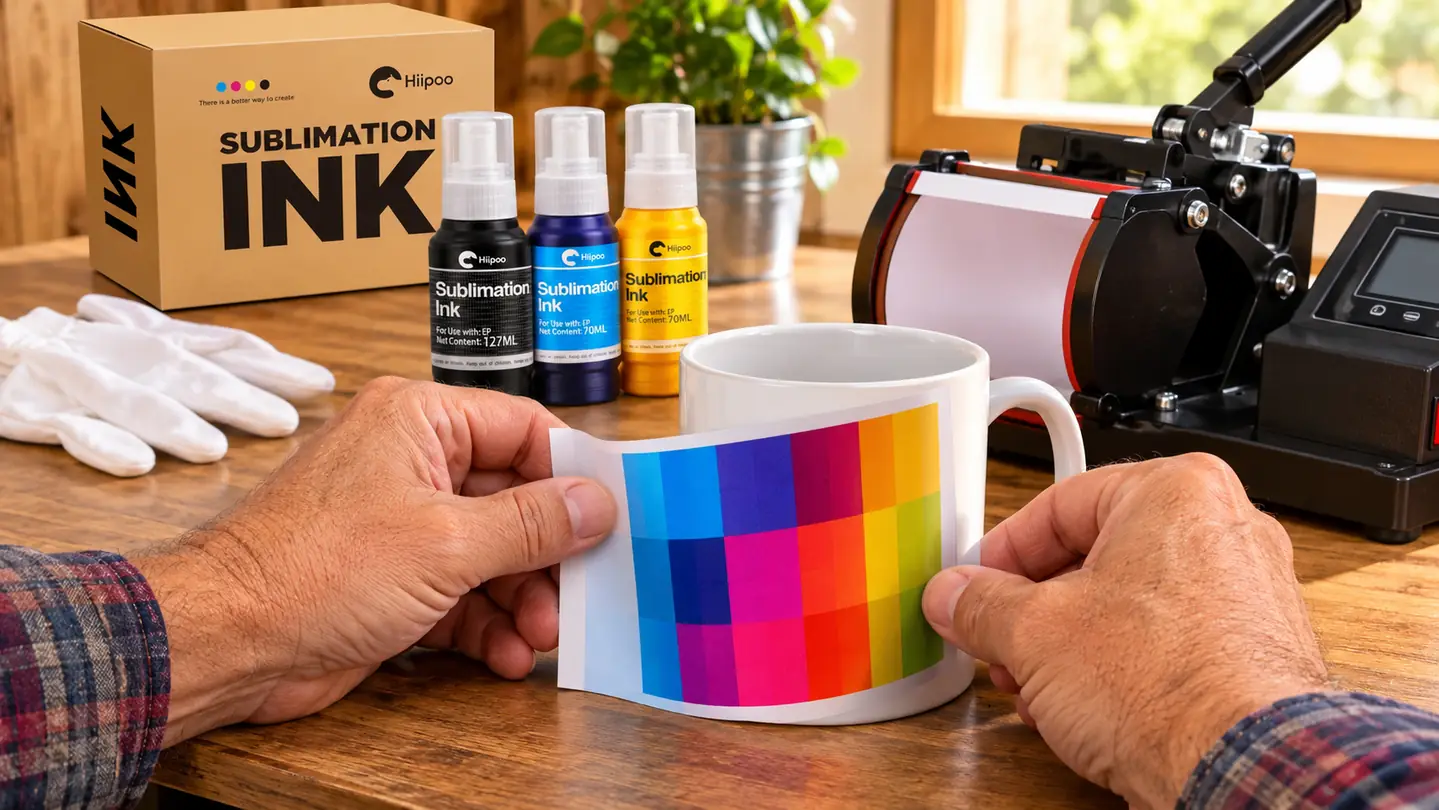
Water based, rated at 7,500 pages, and made for the EcoTank family. This is what has run every mug order out of my spare bedroom since. Check today's price on Amazon.
Amazon See the Hiipoo ink on Amazon →Nothing sits on top of the mug, so nothing can peel
Iron-on vinyl is a layer. It sits on the surface of the mug, and every edge of it is a place where a fingernail, a sponge or a dishwasher cycle can start working its way underneath. Sublimation is not a layer. The printed image turns to gas under heat and bonds into the mug coating, so what your hand feels is the mug itself. I have run my thumb around a finished mug hunting for a seam and there is nothing there to find. That one difference is the whole reason I stopped buying vinyl sheets for drinkware.
Photos and gradients make it onto the mug at all
Vinyl comes in solid colours. If a customer wants a photo of the team on the back of the mug, or a soft gradient behind the league name, vinyl cannot do it and no amount of patience will help. Sublimation prints whatever is on your screen, in full colour, in one pass. Last spring the Little League order had a team photo on one side and the game schedule on the other, thirty-two mugs, and I ran them off one file I had built in an afternoon.
There is no weeding, none, not one piece
Weeding is the part of vinyl work that eats an entire evening. You cut the design, then you sit with a hook and pick the background away from letters the size of a grain of rice, and if one letter tears you swear and start the whole thing again. Sublimation has no weed step. The printer lays the image on the sheet, you wrap the sheet, you press. I have not owned a weeding hook in two years and I have not missed it for one minute of one evening.
The wrap goes all the way around, handle to handle
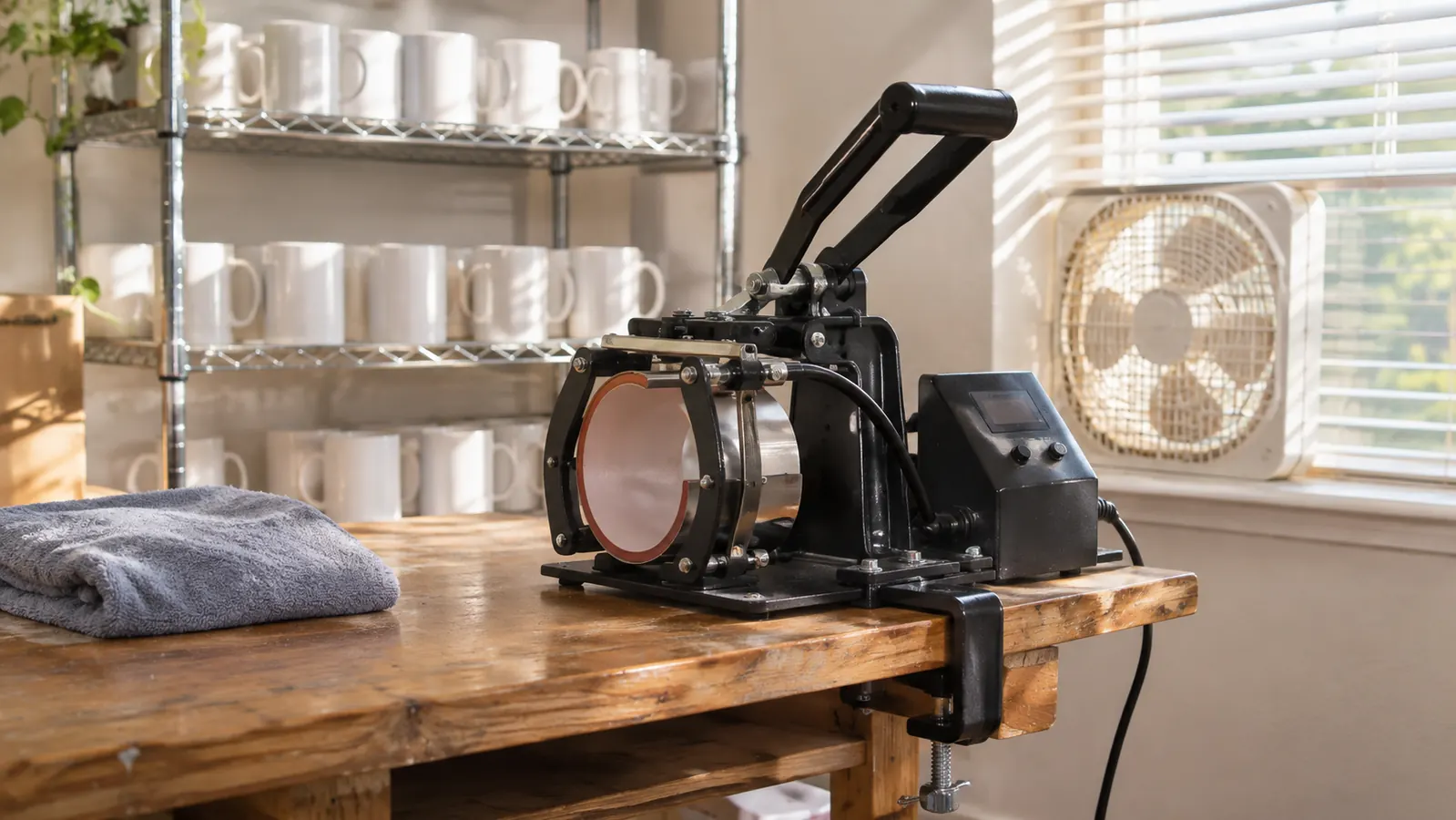
A mug is a curved surface and a hand iron is flat, so vinyl goes on in a strip down one side and stops where the curve gets awkward. A printed transfer sheet wraps the whole circumference and the press squeezes it evenly. The July reunion order had names wrapping all the way around with the year printed underneath, and every mug in that box matched the next. I could not have done that with a roll of vinyl and a mini press, and I tried.
Small type stays readable instead of tearing
Small type is where vinyl goes to die. I did a set of teacher mugs with the name and room number in a script font, and the vinyl kept tearing at the first capital letter until I had ruined four blanks. Sublimation prints small type exactly the way it prints large type, because the printer does not care about the size of the letter. I keep one test mug on my desk with a line of type so small you have to hold it close, and the edges of every letter are still clean.
Three mugs came back in the first month with the vinyl lifting at the rim. Two years and a few hundred sublimated mugs later, not one has come back for a peel.

It survives the way people actually treat a mug
I will not promise you a dishwasher rating, because that depends on the blank and the coating and not on the ink alone. What I will tell you is what is in my own kitchen cabinet. Those mugs have been through the machine several hundred times over two years and the print still looks like the week I pressed it. The vinyl mugs from my first order did not survive one winter. I tell customers top rack out of habit, and I have never had a sublimated mug come back.
Four bottles carry an entire season of orders
The Hiipoo bottles are rated for 7,500 pages, and a mug wrap uses a fraction of one page. I run somewhere between sixty and eighty mugs in a normal month, plus the occasional shirt order, and I have not emptied a full set of bottles inside a season yet. There is nothing dramatic about that. It just means I am not stopping in the middle of an order to drive to the store, and I am not guessing at how much ink is left inside a cartridge.
A reorder looks like the first order
Consistency is the quiet reason people stay. When a customer comes back for eight more mugs to match the ten from last year, I open the same file, fill the tanks from the same bottles and press. The second run lines up with the first closely enough that nobody has ever noticed a difference. With vinyl I was hunting the same dye lot at the craft store and praying the transfer tape behaved the same way twice, and half the time it did not.
It runs in the printer already sitting on your table
I did not buy a new machine to make this switch. The bottles are built for the EcoTank family, the ET-2800 and the ET-2760 and the ET-2400 and the ET-4800 among them, and mine has had nothing but sublimation ink in it since the day I converted it. I only speak for the 2800, because that is the one on my folding table. Fill the tanks, run a head clean, print a test sheet, and you are back to work the same evening.
The same bottles cover the mugs and the shirts
Here is the part that surprised me. The same four bottles handle drinkware and the polyester shirts I sell, and that is what stopped me thinking of this as a mug-only setup. One honest limit, printed right on the bottle: sublimation only works on fabric that is under 30 percent cotton. So my cotton tees still go through vinyl and my performance shirts go through the ink. Two lanes, one printer, and I stopped buying supplies I did not actually need.
What I'd Skip
I would skip iron-on for anything that gets washed and handled, which is every mug I have ever sold. I would also skip sublimation on 100 percent cotton shirts, not because the ink fails but because it will not bond to cotton at all, and the bottle says so before you buy it. And I would skip the cheap uncoated mugs off the big-box shelf. A sublimated image needs a coating to grab onto. Buy two coated blanks and one uncoated one, press all three, and you will learn more in ten minutes than I did in a week of reading forums.
Start with the ink, not the blanks
Hiipoo sublimation ink is one item on my shelf and the one that changed the most about what I can sell. Water based, rated at 7,500 pages, made for the EcoTank models. If your press is already set up, this is the next thing to get right.
Amazon Check today's price on the Hiipoo ink →