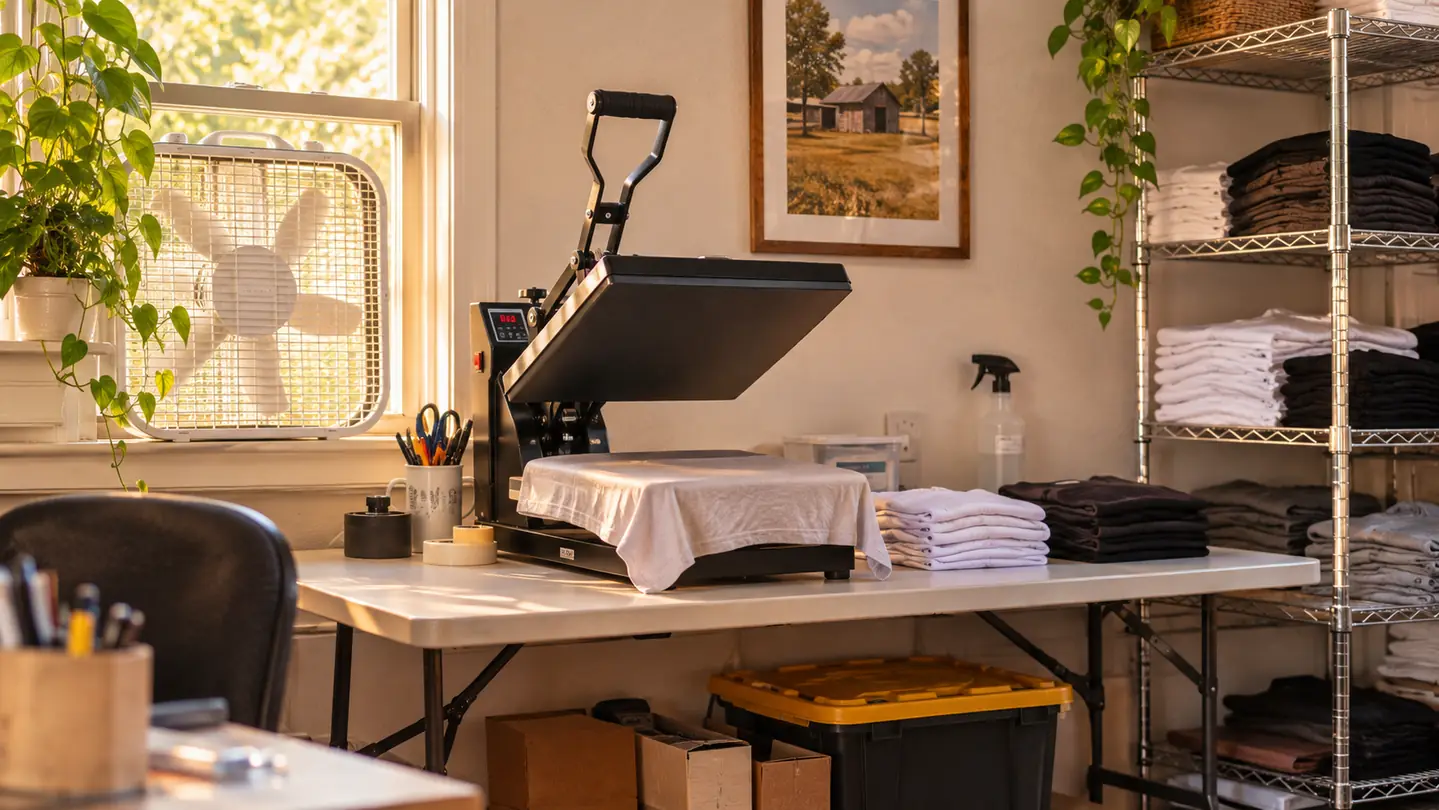
The first order that convinced me this was a real thing was forty six shirts for my cousin's family reunion. I pressed every one of them on a long folding table in the spare bedroom, with a Fancierstudio 15x15 sitting in front of me and a window fan pulling the smell of hot vinyl out into the yard. By Sunday night I had a blistered thumb, a stack of shirts that looked better than the ones we used to pay a print shop for, and a decision to make about whether I was going to keep doing this.
I kept doing it. Three years on, the press still lives on that same table, though the table itself has been replaced once after I leaned on it wrong. The orders now come from neighbors, a Little League team, two teachers' groups, and a small Etsy shop that sells maybe four things a week. This is not a piece about how to get rich pressing shirts in a bedroom. It is about the machine: what a 15 by 15 press does well in a room the size of a walk in closet, what it does badly, and the handful of things I wish somebody had told me before I cut the tape on the box.
The Quick Verdict
Heavy, unglamorous, and honest about what it is: a 15 by 15 inch press with electronic time and heat control, 1800 watts, and a Teflon coated platen. It has taken every shirt, tote, and mouse pad order I have handed it. It is slow to warm up, awkward to move, and no help at all on a hoodie seam.
Amazon Check Today's Price →The machine that has taken every order I have thrown at it
15 by 15 inch pressing area, 1800 watts at 110 volts, electronic time and heat control with a timer that runs 0 to 999 seconds. It is the reason a spare bedroom in Toms River can fill a Little League order on a Tuesday night.
Amazon Check Today's Price on Amazon →How I've Used It
I run this press evenings and Saturdays, somewhere between ten and eighteen hours a week depending on the season. Spring is Little League. Late spring is graduations and reunions. August is back to school shirts for the two teachers' groups, and December is a wall of tote bags and holiday shirts that I start in October and still finish late. In a normal month I press somewhere between three hundred and five hundred pieces. In a bad month, meaning a good month, more.
The work is mostly flat goods. Adult t shirts, youth t shirts, a run of onesies for a neighbor's grandbaby, canvas tote bags, mouse pads, aprons for a church fundraiser, and a great many rhinestone templates for the teachers, who like a bit of sparkle on a spirit day shirt. Sublimation prints on polyester go through here too. I run one Epson EcoTank ET-2800 that has only ever had sublimation ink in it, and the press is the place where those prints turn into shirts instead of sheets of paper.
What that volume taught me is that a heat press is not really about the press. It is about repeatability. When you have forty shirts in front of you and the first one came out right, you want the thirty ninth to come out exactly the same, and you do not want to think about it at eleven at night. That is the thing this machine does better than I expected. In three years the Fancierstudio has not needed a service call, a replacement part, or a call to anybody. The only thing I have bought for it is a second Teflon sheet.
What a 15x15 Platen Actually Covers
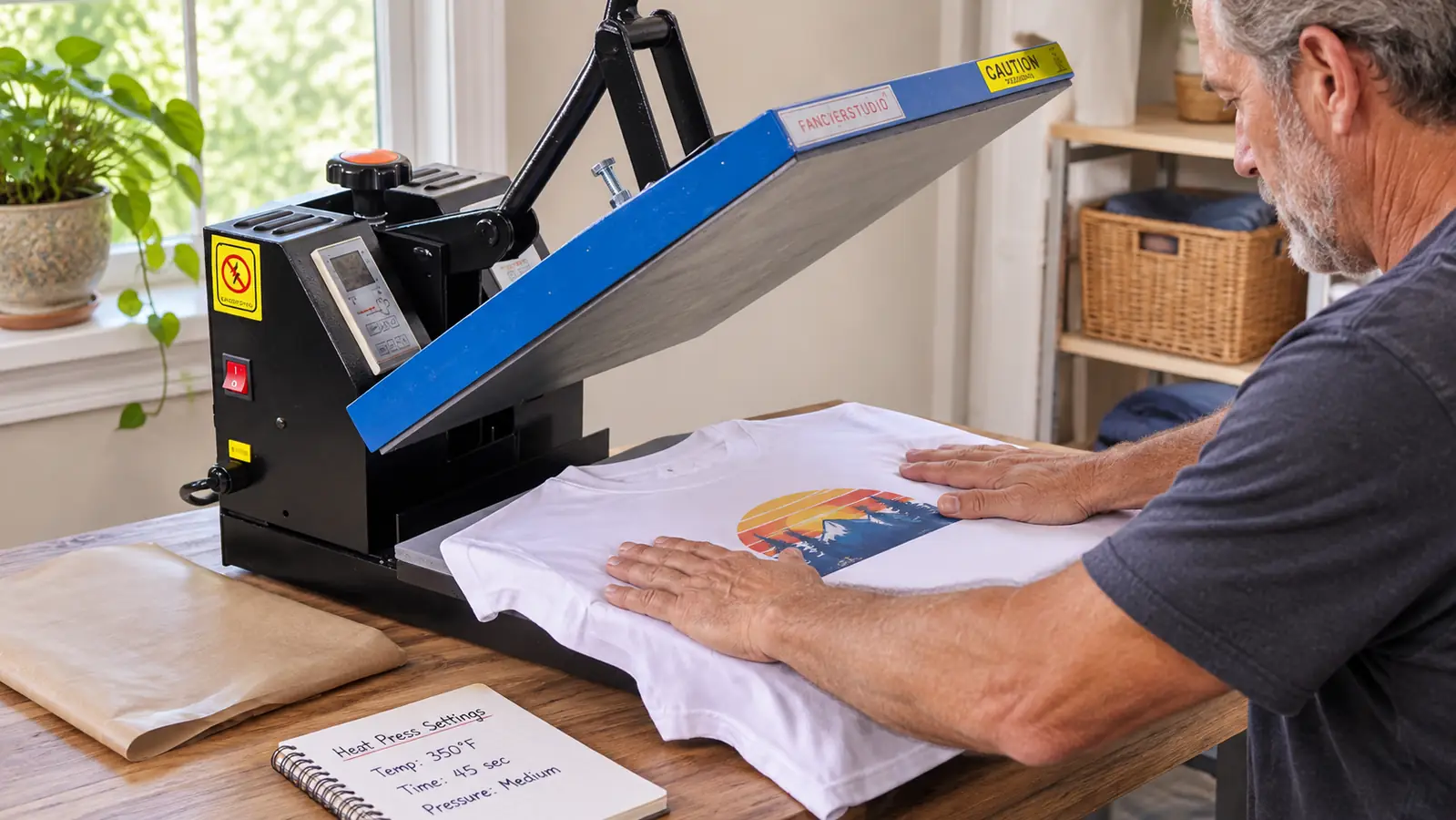
Fifteen inches by fifteen inches sounds enormous until you lay a 2XL shirt on it. A standard adult front print, the kind that runs maybe eleven inches wide, fits with room to spare on all four sides. A youth shirt fits twice over. A tote bag lies flat with the handles draped off the edge, and a mouse pad or a set of coasters fits inside the platen with enough space left for a second one if you are careful about placement and do not mind a small margin of error.
What does not fit is a full back print on an adult 2XL, or any of the all over patterns that are popular right now. For those I either shrink the design or press in two passes and accept a seam line through the middle, which I hate and which customers can see if they look. The other thing that does not fit is a hoodie. Not the front, the front is fine. The problem is the seam where the hood meets the shoulder, the zipper on a zip up, and the kangaroo pocket where you end up with three layers of fabric stacked under one platen. I have pressed hundreds of crewneck sweatshirts on this thing and I still get nervous on a zip up.
Sleeves are their own conversation. You can press a sleeve on this platen if you fold it flat and accept that you are pressing through two layers of shirt, which is fine for a small cuff print and not fine for anything bigger than that. A dedicated sleeve platen is the real answer. I have not bought one, because sleeves are maybe four percent of what people order from me. If sleeves were forty percent of my orders, my answer would be different, and so would this review.
Heat, Time, and the Settings I Keep Coming Back To
The controller is electronic and it does exactly what the listing says it does. You set a temperature, you set a time, and it holds them. The temperature range runs from 0 up to 699 degrees Fahrenheit and the timer runs from 0 to 999 seconds. I have never gone anywhere near either ceiling, and I would be nervous about anybody who has. Most of my work sits between 320 and 380 degrees, with sublimation on polyester up around 400 and a press of twelve to fifteen seconds depending on the blank. There are about a dozen settings written in my notebook that I use over and over, and that is the whole job.
The piece I did not expect to care about is the Teflon coating on the platen. It means a stray bit of adhesive or a slightly crooked rhinestone template does not weld itself to the heating surface and cost me twenty minutes with a scraper. You still want the Teflon sheet that comes with the press between the platen and the shirt, especially on anything with a printed transfer, but the coating has saved me a scrubbing session more than once, and I notice it every time I press rhinestones.
Two habits worth building in the first week. First, give it time to come up to temperature and then give it another two or three minutes to settle. Mine overshoots the set point on the way up and then eases back down, so if I start pressing the second the readout hits 350, the first shirt of the night runs hot and the vinyl goes shiny. Second, keep a spiral notebook. Temperature, time, blank, result. It sounds like homework. It is the difference between a shirt you can repeat and a shirt you are guessing at, and guessing is how you end up with a stack of seconds nobody will buy.
Where This Press Fought Me
The Fancierstudio measures 33 inches long by 23 inches wide by 20 inches high, and those numbers are real. This is not a machine you tuck into a closet and pull out when inspiration strikes. It took two of us to get it up the stairs, my husband Sal on the bottom and me on the top, and it has not moved since. Measure your table and measure your doorway before you order, because I have a friend who did not, and her press spent a month in the front hall.
Warm up is slow. Ten minutes before it is truly usable, and longer in February when the spare bedroom is cold because I refuse to heat a room I am only in for an hour. That matters when you have forty minutes after dinner to knock out six shirts for a teacher who needs them tomorrow. I have learned to turn it on before I sit down to eat, which Sal finds funny and I find necessary.
The warranty is three months, and I want to say that plainly because nobody says it plainly. Mine has run for three years without a problem, but a three month warranty tells you something about how much confidence is behind the machine, and if you are the sort of person who needs a long safety net, that is a fair reason to look at something else. My other complaints are smaller. The upper platen is hot and open when you lift it, so anything plastic near the table is a bad idea. The room needs ventilation, because vinyl and polyester both smell like a chemistry lab when they are hot. And I have scorched exactly one polyester shirt in three years, at 400 degrees, because I answered a text message in the middle of a press. That one was mine, not the machine's.
What I'd Tell Someone Buying a First Press
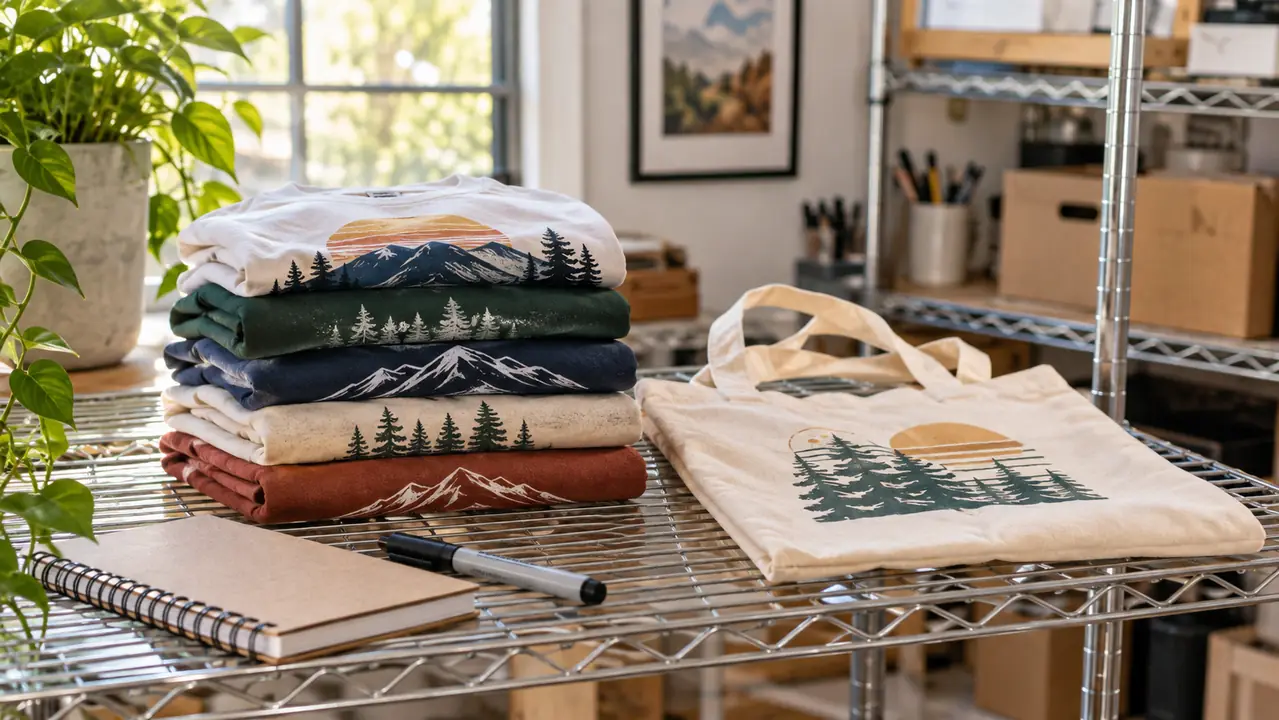
Buy it for the platen, not for the name on the side. Fifteen by fifteen is the size that covers the overwhelming majority of what a home shop actually sells: fronts, backs on medium shirts, totes, pads, aprons, and small blanks. If you are going to spend money on anything beyond the press itself, put it into Teflon sheets, a heat resistant mat for the table, and a roll of parchment for the shiny materials. Those are the things I reach for every single week.
If you are deciding between this style of press and a swing away, that is a real decision and it depends almost entirely on your room. I wrote the longer version of that argument in my notes on [clamshell versus swing away heat presses](/clamshell-vs-swing-away-heat-press), and there is a separate piece on [why a clamshell press suits a spare room](/10-reasons-a-clamshell-heat-press-fits-a-spare-room). The short version is that this one takes up less floor space when it is open, which is the entire reason it sits on my table instead of living in the garage under a sheet.
Practice on thrifted shirts from the church rummage sale before you touch anything a customer is paying for. Ten shirts at two settings each will teach you more than any video you can watch, because you will see how the fabric behaves and how the vinyl releases while it is still warm. And when you land on a setting that works, write it down the same night. You will not remember it in three weeks. I promise you will not.
What I Liked
- A true 15 by 15 inch pressing area, enough for adult fronts, tote bags, mouse pads, and aprons
- 1800 watts at 110 volts holds temperature through a long run of shirts instead of dropping between presses
- Electronic time and heat control with a timer that runs 0 to 999 seconds, so a setting you like repeats exactly
- Teflon coated platen shrugs off stray adhesive and crooked rhinestone templates
- Simple enough that I pressed my first sellable shirt the same week it arrived
Where It Falls Short
- 33 by 23 by 20 inches and genuinely heavy. It took two people to carry it upstairs and it has not moved since
- Ten minutes or more to come up to temperature, longer in a cold room
- Three month warranty is short for a machine that runs this hot
- No answer for hoodie seams, zip ups, sleeves, or anything curved
- The open upper platen is hot and exposed, and the room needs real ventilation
Forty six reunion shirts, a Little League season, and several hundred teacher tote bags later, the only thing I have had to replace is the Teflon sheet.
Who This Is For
This is for the person pressing in a spare bedroom or the corner of a garage who needs one machine that handles shirts, totes, and flat blanks, and who would rather learn a plain tool than pay for features they will never touch. It is for the team mom with twelve jerseys and a Tuesday deadline. It is for the teacher who wants thirty tote bags finished before the first day of school. It is for the Etsy seller doing four orders a week and wondering whether a real press is worth the floor space it eats. In my room, it was, and it still is.
Who Should Skip It
Skip it if you are pressing full back prints on big shirts all day, or hoodies, or sleeves, or anything with a curve to it. A 15 by 15 flat platen is the wrong tool for a tumbler, a cap, or a shoe, and no amount of technique fixes that. Skip it if you cannot get a 33 by 23 inch machine up a flight of stairs, or if your only work surface is the kitchen island you also eat dinner off. And skip it, honestly, if you are not sure you will use it. This is a machine that rewards repetition. A press that sits folded in a closet for eight months is a press that ends up listed for sale in the spring, and that is a waste of your money and your goodwill.
Three years, one Teflon sheet, and a table that never got its space back
If your orders are flat and your room is small, this is the press that fits both. A 15 by 15 inch platen, 1800 watts at 110 volts, electronic time and heat control, and a Teflon coated plate that has not quit on me yet.
Amazon Check Today's Price on Amazon →