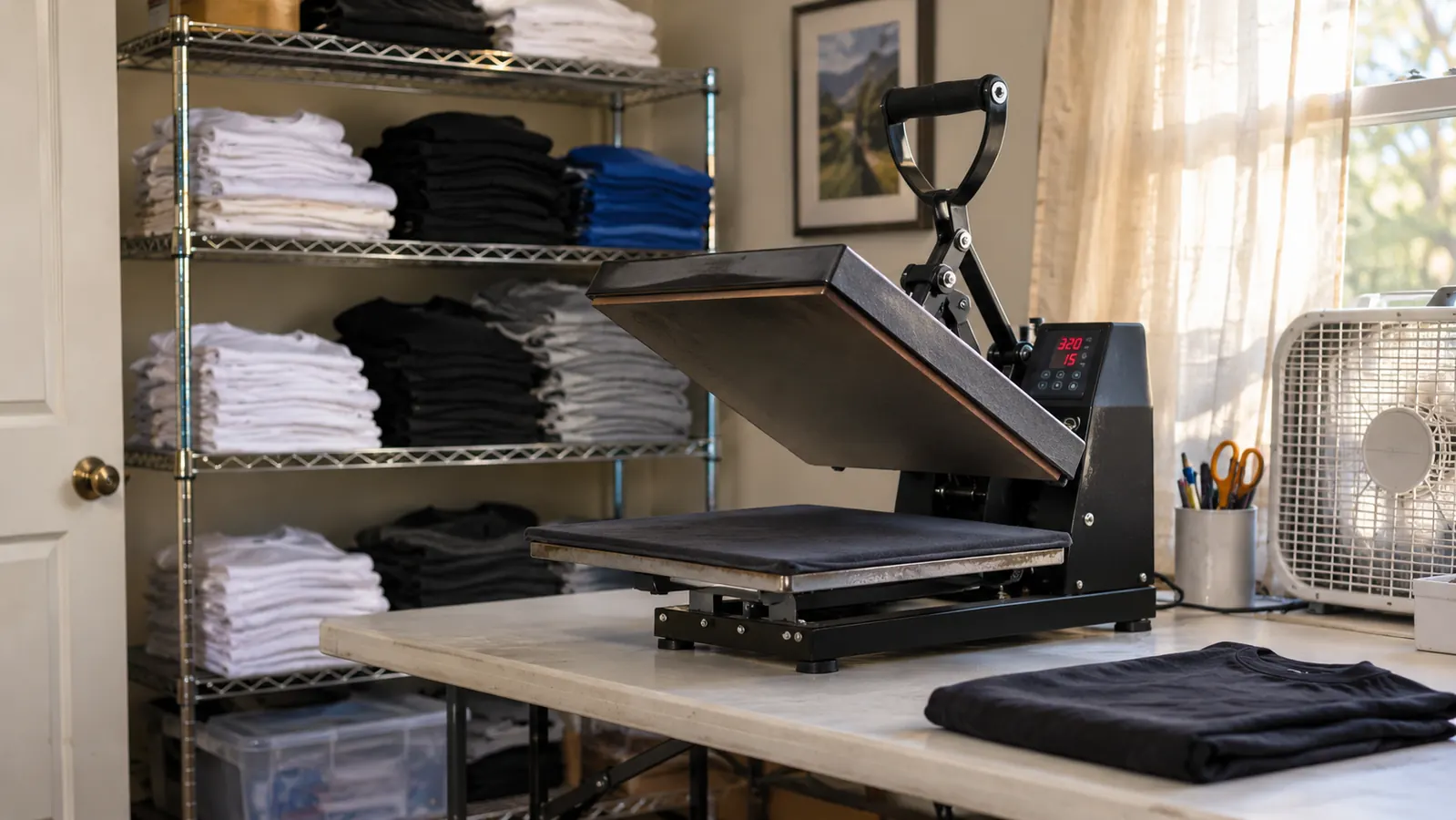
The question usually arrives while someone is standing in my spare bedroom looking at the press on the folding table. Should I buy the flat one that opens like a suitcase, or the one with the arm that swings out of the way? Three years and roughly 1,100 shirts later, my answer is that those two machines are not really competing for the same job. The Fancierstudio 15x15 clamshell wins on space, on setup time and on what it takes to find out whether you even like this work. A swing-away press wins on threading awkward blanks, on holding pressure and on how many pieces it will push through in an afternoon.
Here is the short version. If your press lives on a folding table in a room that also holds a guest bed, buy the Fancierstudio. If you have a dedicated room, a wholesale blank account and a stack of totes waiting on you, save longer and buy the swing-away. Everything below is the reasoning, including the places where the swing-away is plainly the better machine.
| Fancierstudio 15x15 | Swing-Away Press | |
|---|---|---|
| Platen size | 15 x 15 inches. Front prints and most youth sizes in one press | Often 16 x 20, so a full adult back print fits without repositioning |
| Dressing the shirt | Lower platen is fixed to the frame. You work the shirt down over it | Arm swings clear, so you lay the blank flat first |
| Pressure on collars and totes | Clamshell arc. I check the knob with a scrap shirt most sessions | Straight down. Easier to hold even pressure across a thick seam |
| Warranty | 3 month warranty on the listing | The swing-away machines I looked at advertise a year or longer |
| Footprint | 33 x 23 x 20 inches. Lives on a folding table with room to spare | Needs clearance for the swing, plus a heavier frame |
| Controls | Electronic heat and time control. 0 to 699 degrees F, 0 to 999 seconds | Comparable digital controls on most models |
| Machine to learn on | One handle, one knob, one readout. I pressed a wearable shirt the first night | More machine, and more to get wrong before your first good press |
| Getting started | The lowest entry point in this size class | A serious step up, and the frame is built for daily volume |
| Taking it somewhere | Fits in a trunk alongside the folding table | Two people and a truck, or leave it where it sits |
Where the Fancierstudio 15x15 Wins
Space is the first thing, and it is the thing nobody puts on a comparison chart. The Fancierstudio measures 33 inches long, 23 wide and 20 tall, and it stays inside that box while it works because the top plate comes down instead of swinging away. My press room is the spare bedroom. There is one long folding table against the wall, a wire shelf of blanks, and a window fan that runs all summer. A swing-away in that same room would need a clear arc on one side, which is exactly where Sal piles the boxes he is supposed to be sorting. So the practical version is this: the clamshell fits the room, and a press that does not fit the room becomes a press you stop turning on by March.
I know that because I measured before I bought. I stood in the doorway with a tape measure and a scrap of paper, marked 33 by 23 inches on the carpet with painter's tape, and then taped out a second box with an extra two feet on the right to see what a swing would cost me. The second box ran the folding table right up against the wire shelf, and the shelf is where the blanks live. That settled it in about ten minutes, before I had read a single review.
The second thing is how little there is to learn. One handle, one pressure knob, one readout. The listing describes electronic time and heat control, a temperature range of 0 to 699 degrees F and a time range of 0 to 999 seconds, and that is honestly all the control there is. I set my two numbers, pull the handle down, watch the timer, lift. The first night I had it I pressed a shirt I was willing to ruin and it came out wearable. That matters more than it sounds. The first few weeks of this work are a string of small errors, and you want a machine that lets you make them without much consequence.
The third is the arc itself. The handle comes down on a curve, so the platen meets the shirt from the back edge forward. That is not a defect, it is how a clamshell is built, and for a t-shirt, a tote bag or a mouse pad it does the job. The listing's own recommended uses are bag, mouse pad and t-shirt, which tells you what the machine was designed around. I press mostly shirts. It has been enough.
Where a Swing-Away Press Wins
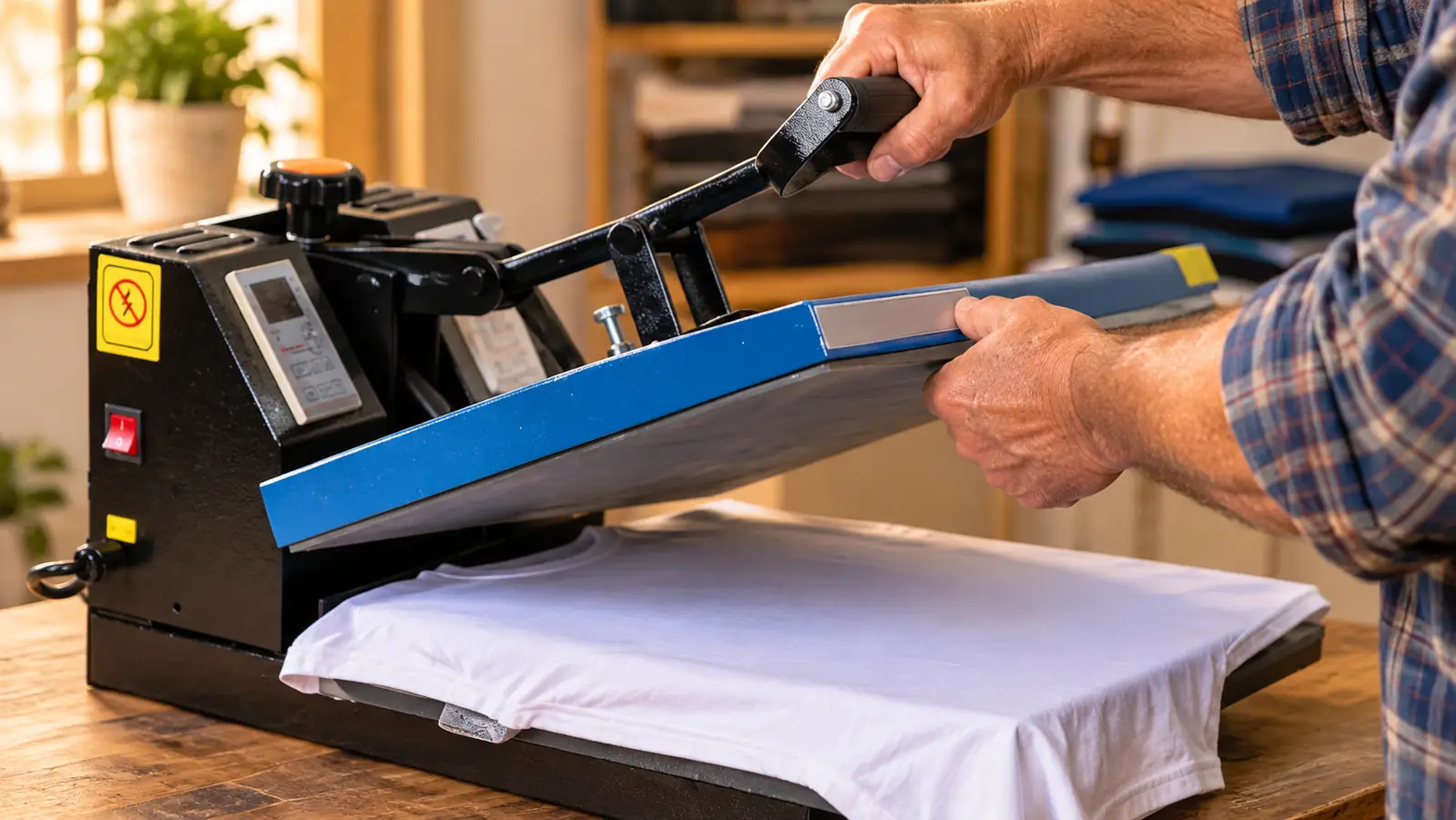
Threading. This is where the difference stops being theoretical. On a clamshell the lower platen is bolted to the frame, so you dress the shirt down over it, reaching underneath, feeling for the seam, straightening the collar with your hands in a gap that was not really built for hands. On a swing-away, the arm and the upper plate move out of the way and the whole platen sits open. You lay the piece flat. You look at it. You fix the seam. Then you swing back and press. For bags, thick canvas, and anything with a zipper or a gusset, the swing-away saves real minutes on every single piece.
I found that out on a batch of nine canvas totes for a teacher's group in the fall. On my press I had to open each bag, work the flat side down over the platen, and keep the handles from flopping under the plate while I pulled the handle down. The first one took me eleven minutes. By the ninth I was down to seven, and that was the good news. A woman I buy blanks from in Brick does the same job in about ninety seconds a bag, and she is not faster with her hands than I am.
Pressure is the second win. A clamshell applies force along that arc, and on flat cotton you will never notice. On a tote seam or a hoodie pocket you will. My routine on anything thick is press, lift, shift, press again, then check it with my thumb. A swing-away presses straight down and holds the pressure where you set it, so the piece comes out flat the first time. The third win is the boring one: warranty. The Fancierstudio listing carries a 3 month warranty. The swing-away machines I looked at advertise a year or longer, and if you are pressing most days that gap is the difference between a tool and a gamble. That gap is not a reason to buy the bigger machine if you press twice a month. It is a reason to think hard about it if you do not.
The press that fits the room you actually have
15 x 15 platen, electronic time and heat control, 1800 watts on a standard 110 volt circuit. It is the machine I started on and still run most evenings in the spare bedroom.
Amazon Check Today's Price on Amazon →The Specs That Actually Change Your Day
The number I never thought about until it mattered is 1800 watts on 110 volts. That is a real draw, and my spare bedroom shares a circuit with the window fan and, in January, a space heater. The first cold Saturday I ran all three and popped the breaker halfway through a set of six shirts. Nothing was damaged. I moved the heater out to the hallway and stopped pressing with the fan on high. If your press room is a converted bedroom, find the breaker before you find out the hard way.
The 0 to 699 degree F range is more than I use. Cotton with vinyl runs well below the top of it, and polyester is lower still, which is how I scorched a spirit shirt early on by treating it like cotton. The 0 to 999 second timer is the part I lean on most, because it means I can set 45 seconds for a shirt and 60 for a tote and stop counting in my head while I am also answering a text about a Little League order.
What I did not expect is how much of my work sits in a narrow band in the middle of that dial. Sublimation on a polyester tumbler blank wants one number held steady. Vinyl on a cotton shirt wants a fair bit less. The readout stays where I put it, which is not a small thing on a machine at this entry point, and the timer counts down instead of up, so I can glance over from the printer and know exactly how many seconds are left without doing arithmetic with ink on my fingers.
Two more details from the listing turned out to matter. The platen has a Teflon coating, so a stray bit of adhesive or a hot vinyl edge does not weld itself to the plate. A 15 by 15 inch heat press sheet comes in the box with it. I still lay parchment over sublimation blanks because it keeps the paper from sliding, but for heat transfer vinyl the coating is one less thing to babysit. The 15 by 15 platen covers a standard adult front print with room to spare, and handles youth sizes two at a time if you mind the seam.
What Broke and What Held Up
In three years the only thing I have replaced is the Teflon sheet on top of the platen, twice, because vinyl edges and repeated pressing eventually dull it. The platen coating underneath has held. The pressure knob drifts, so I check it against a scrap shirt at the start of every session. That takes about twenty seconds and has saved me more jerseys than any other habit I have picked up. The frame does not walk across the table when I press, which I did not expect from a machine sitting on a folding table.
Twice I have had a vinyl design lift at a corner on the first wash, and both times the cause was me, not the press. Once the shirt had a heavy seam running right under the design and I pressed it anyway. Once I got impatient and pulled the carrier sheet while the piece was still warm. Sal now wears both of those shirts around the house, which is his job, and I have a rule about waiting for a full cool before I peel anything, even when the order is late and the porch light is already on.
The honest limitation is the arc, and I have now said it twice because it is the thing you will notice first. Thick seams need two presses. Hard blanks like mouse pads want lighter pressure than a shirt does. And there is no way around dressing the shirt on a fixed platen, so if your orders skew toward totes and bags, you will feel the clamshell shape in your shoulders by the end of a Saturday.
The 3 month warranty is short and I am not going to dress it up as anything else. Mine has not needed it. But if you are the sort of person who wants a company standing behind the machine for years, that number should sit in your head while you decide.
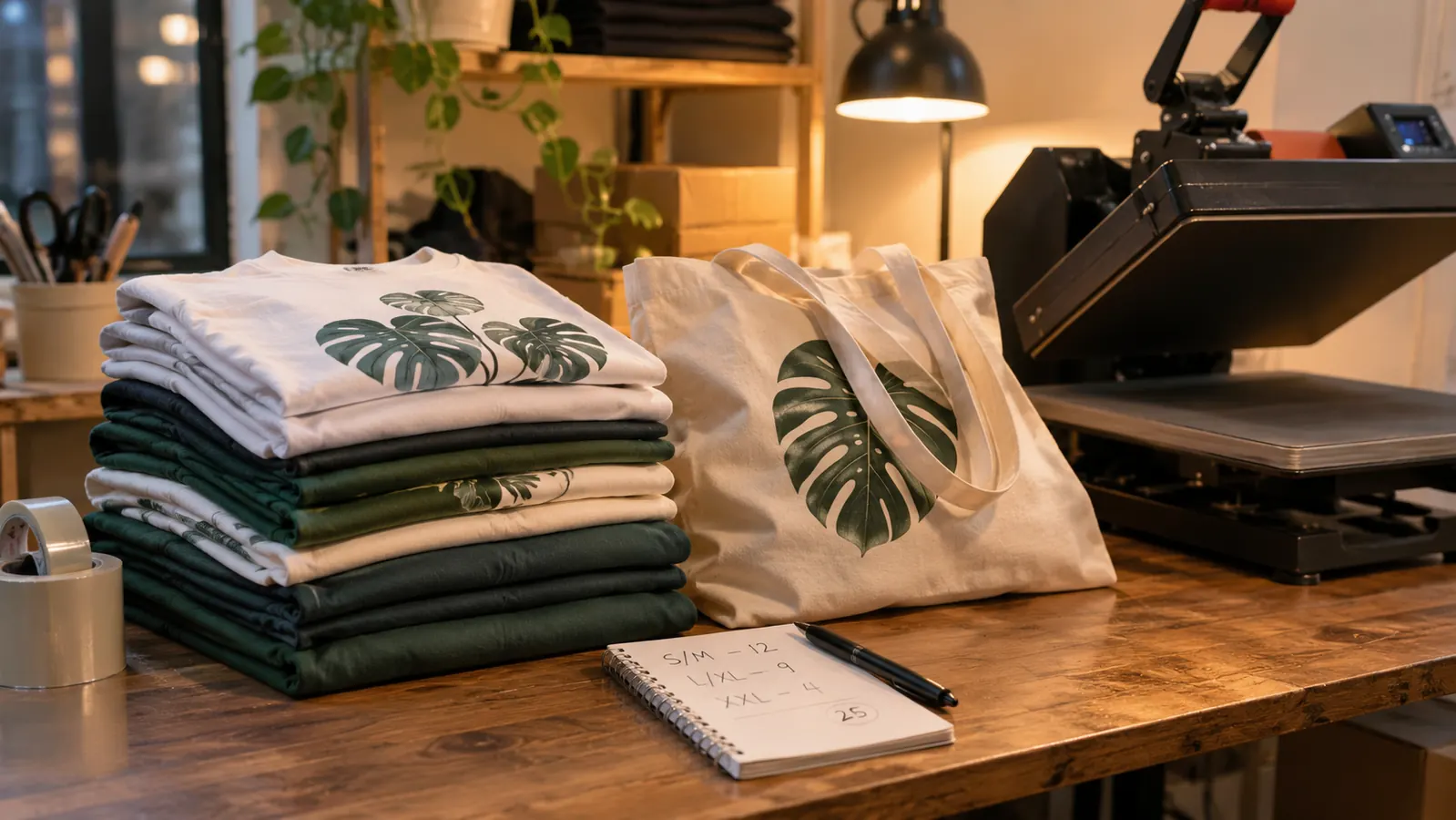
Roughly 1,100 shirts across three years, two replaced Teflon sheets and one tripped breaker. The press that earns its keep is the one that fits the room you actually have.
Who Should Buy Which
Buy the Fancierstudio if the press is going into a bedroom, a garage corner, or a dining room that has to go back to being a dining room by Sunday night. Buy it if your orders are mostly flat things: shirts, bags, mouse pads, the odd apron, and you are pressing evenings and Saturdays rather than running a shift. Buy it if you are not certain yet whether this work is for you, because it is the least costly way to find out, and it stays useful as a backup when you eventually outgrow it.
Buy the swing-away if you have clearance on one side of the machine and you are pressing most days. Buy it if totes, hoodies, thick canvas and anything with a gusset make up a real share of your orders, because that is where straight-down pressure and an open platen pay you back in minutes and in fewer redos. Buy it if a warranty measured in years matters more to you than a low entry point, and if you have someone who can help you move it.
The middle path, and the one I would take if I were starting over with what I know now: buy the Fancierstudio, press for a year, and keep a notebook of the pieces you turn down because they are awkward. Let that list tell you when to upgrade. Mine filled up with totes at about fourteen months.
Fits the table, fits the room, fits the first year
15 x 15 platen, electronic time and heat control, Teflon coated plate, and a heat press sheet in the box. It is the machine I still turn on most evenings, and the one I would hand to anyone pressing their first fifty shirts.
Amazon See Current Price on Amazon →