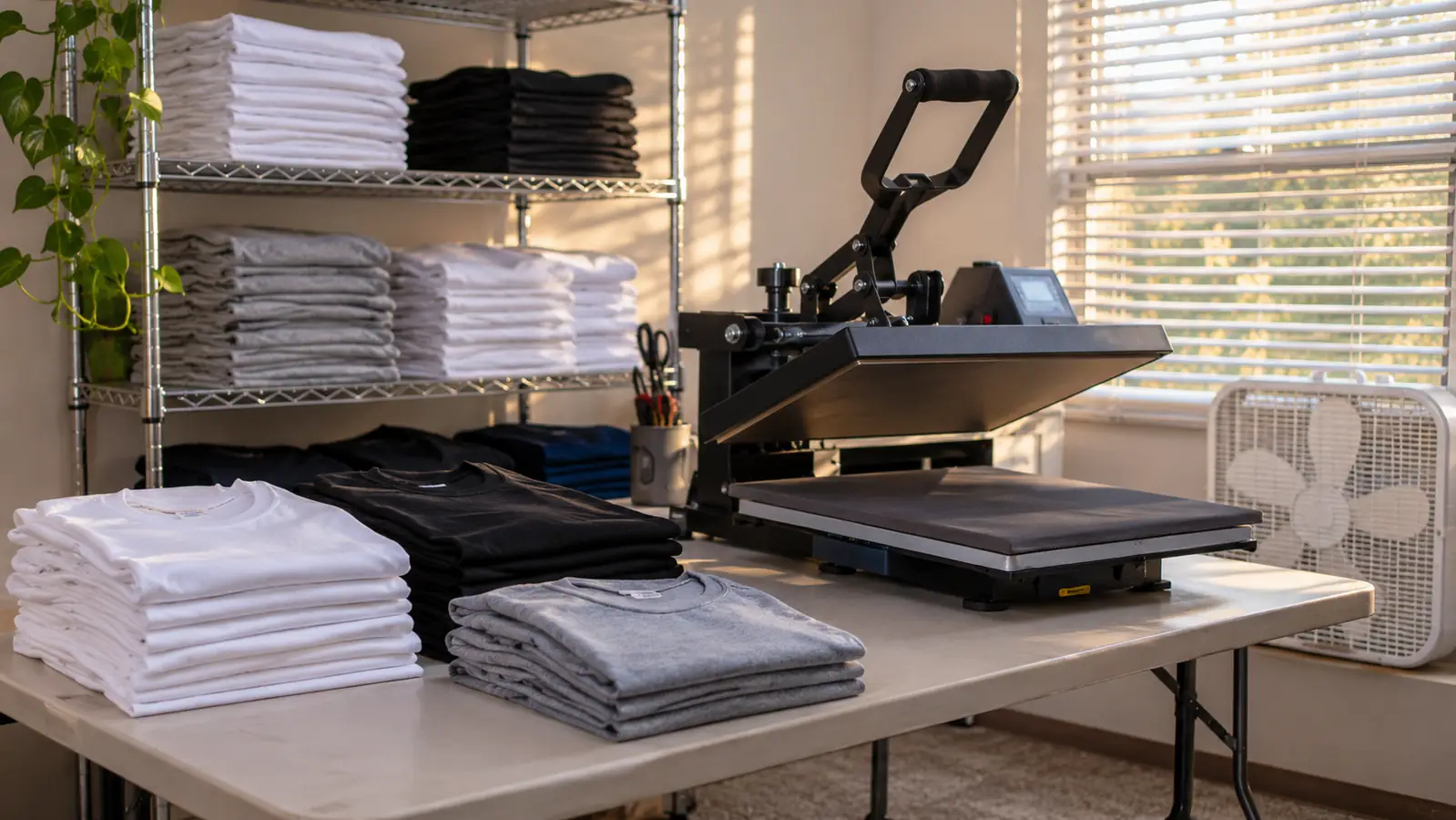
I have had the Fancierstudio 15x15 on the same long folding table in my spare bedroom for a little over a year. Long enough that I no longer open the manual before a run of shirts. Long enough that I scorched a poly blend last spring badly enough to drop it straight into the rag bin before Sal could see it. So this is not a first week unboxing dressed up as a review. This is the version I wish somebody had handed me before I gave up half my workroom to a machine that measures 33 inches long, 23 inches wide and 20 inches tall. My notes on how it has held up across a year of orders live elsewhere on this site. What follows is the other half of the story, the part that shows up in month three, when the novelty is gone and a Little League order is due on Friday.
Here is the short answer, then I will show my work. The press does the job. It presses flat goods squarely and evenly, the electronic controls set heat and time without any guessing on my part, and it has not given me one mechanical failure in a year of evenings and Saturdays. It also carries a three month warranty, a spec sheet that argues with itself, and a footprint that swallowed my table. Both things are true at once, which is why I am writing this instead of leaving five stars and moving on.
The Quick Verdict
A genuinely capable 15 by 15 press for flat goods, held back by a three month warranty, a temperature spec that contradicts itself, and a table hungry footprint.
Amazon Check Today's Price →The press that survived a year of Friday team shirt orders
15 by 15 inch pressing area, 1800 watts, electronic time and heat control. Read the warranty line yourself before you clear a table for it.
Amazon Check Today's Price on Amazon →How I've Used It
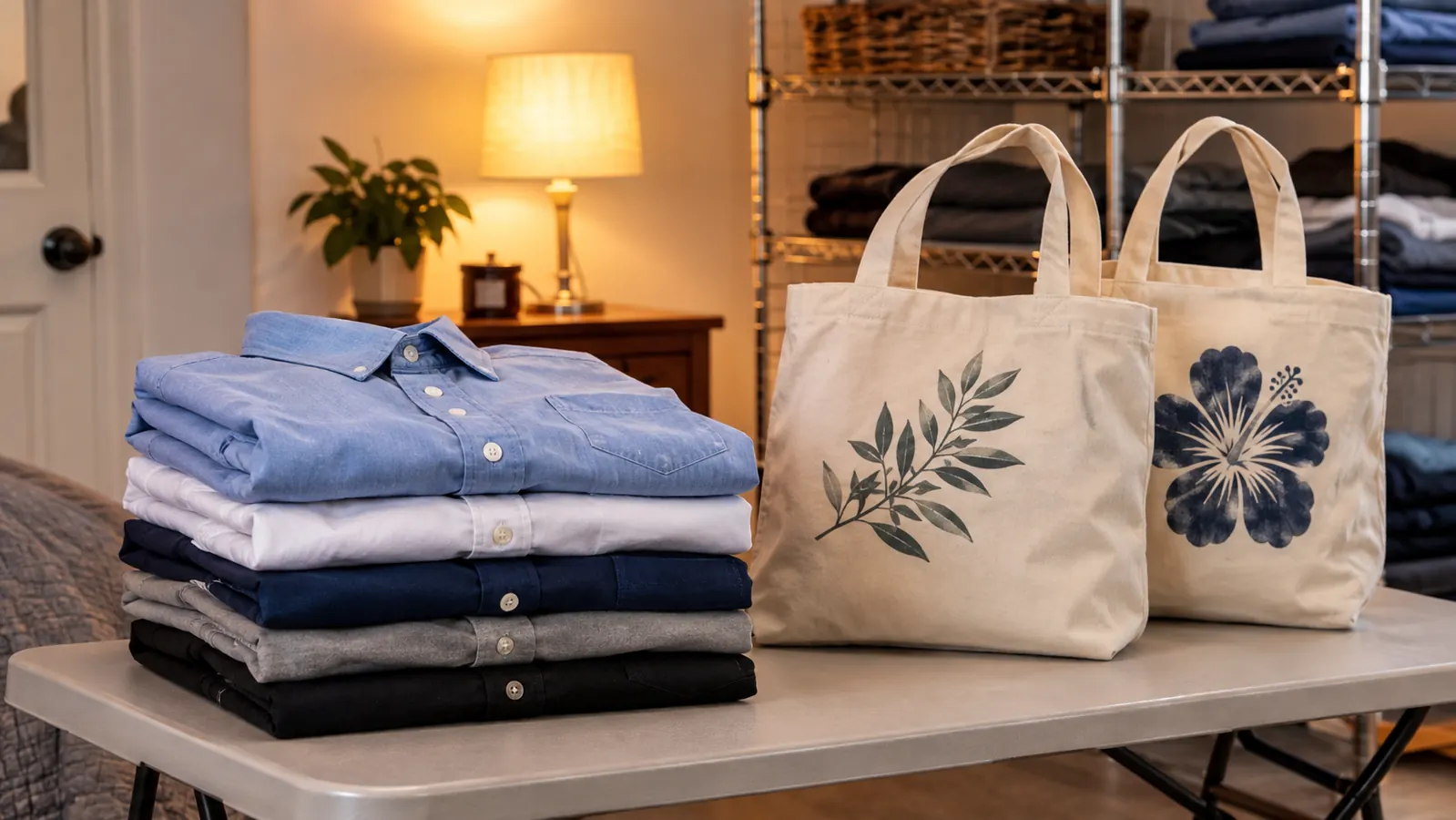
It has been here a little over a year. In that time it has run family reunion shirts in July, teacher shirts in August, Little League team gear in the spring, tote bags for a school fundraiser, mouse pads for my small Etsy shop, and a run of holiday shirts in November that I would rather not repeat. I work evenings and Saturdays, part time, out of one spare room with one folding table and a wire shelf of blanks. Sal folds and bags and serves as test wearer, which means he has gone to the grocery store in more misprinted shirts than any retired man should have to.
The Fancierstudio box came off a delivery truck on a Tuesday and took two of us to walk in from the porch. Sal held the door, I held the frame, and we set it down on the folding table I had already measured twice. A 15 by 15 press is bigger in person than any listing photo prepares you for. I stood there looking at it for a solid minute, then moved the wire shelf six inches to the left so I could lift the top without catching my elbow on the corner of it.
My first serious run on this machine was eighteen shirts for a family reunion, and six of them were bad. I blamed the press for about an hour. Then I sat down and thought about what I had actually done. I had peeled transfers while they were still hot. I had slid a shirt a half inch on the pad to straighten it and pressed it anyway. I had stacked a thick collar seam right under the platen and then wondered why one corner would not bond. Not one of those failures belonged to the machine, and every one of them cost me a blank shirt.
What the machine did do, from the first week, was press evenly across the full 15 inches. That matters more than it sounds. A 15 by 15 area covers an adult front print in a single pass, so I am not walking a smaller platen around the design and hoping the seams line up. When a shirt failed that first month, it failed because of what I did in the ten seconds before the platen came down. That is the honest split, and it has held for a year of orders.
Somewhere in month two I stopped trusting my memory and started trusting masking tape. There are three lines on the tape now. One for cotton shirts, one for the poly blend I press for sublimation work, one for tote bags. Each line has a temperature and a time written next to it. I stick it to the table edge and I do not move it. Nothing on this panel remembers my numbers for me, so the tape remembers them instead. It is not elegant, but neither am I, and it has not failed me once.
Not one shirt in my first month failed because of the machine. They failed because of what I did in the ten seconds before the platen came down.
What the Listing Does Not Tell You
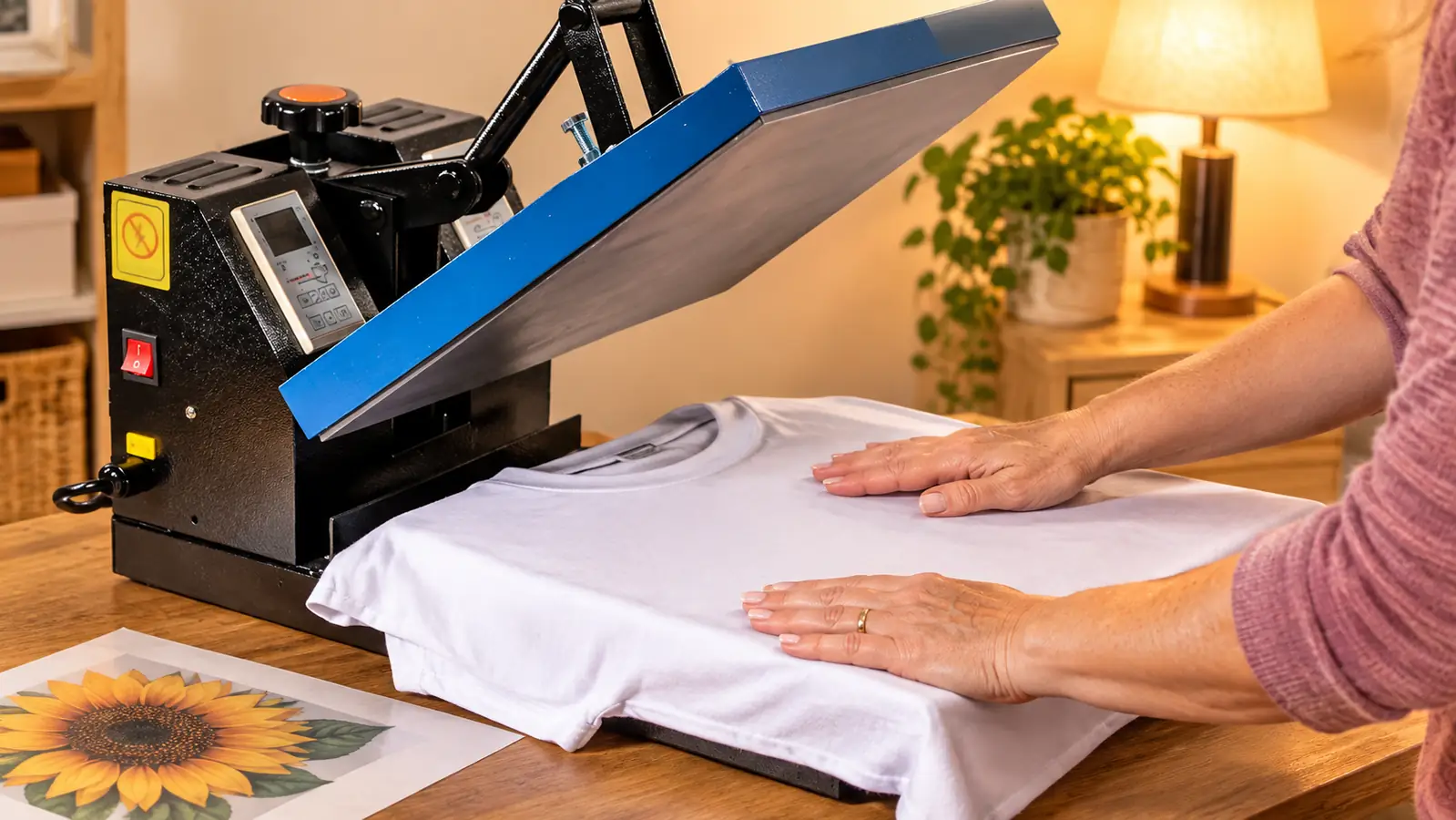
The listing promises electronic time and heat control with a precise time set up. That is accurate, and it undersells the day to day. On my old setup I counted seconds in my head and got it wrong often enough that a stack of shirts would come out uneven. Here I set a number for the heat and a number for the seconds, bring the platen down, and repeat. There is no touchscreen on this machine, no preset menu of fabric types, and nothing in the listing that suggests an app or a phone connection. What you get is two numbers and a platen that goes exactly where you put it. For a part time operation like mine, that is enough. I would rather have two honest numbers than a menu I never touch.
The second thing the listing mentions almost in passing is the Teflon coating on the heat platen. I did not think much of that line when I ordered. A year in, it is one of my favorite details. Shine marks on dark shirts are the small humiliation of this work, and the coated surface cuts them down considerably. It is not armor. I still keep a cover sheet on the table for anything fussy, and I still ruined a good shirt in February by leaving it under the platen while I answered the door.
There is also no real manual to speak of. What comes in the box is a folded sheet with a diagram and a few lines of text, and it does not resolve the temperature question for you. I learned my settings from a scrap shirt, a laundry marker and a wash cycle, and I would suggest you plan to do the same. A press like this is forgiving of a careful beginner and unforgiving of a careless one, which has been true of every machine I have ever owned.
Then there is the paperwork, which is where this review turns. The temperature range in the listing runs from 0 to 699 degrees Fahrenheit. Four lines later, the upper temperature rating is given as 500 degrees. Those two numbers do not agree, and nobody at the company has explained it to me, because the documentation in the box is thin and the warranty is three months. I am not telling you the press is unsafe. I am telling you that if you are the sort of person who needs a clean answer from a spec sheet before you buy, this is not the machine that gives you one.
Fifteen by fifteen also sounds enormous until you are pressing the back of a double extra large shirt. A full back print on a big shirt still needs care in how you load it, and a thick side seam can sit right under the edge of the platen if you let it. That is not a flaw in the machine. It is the reality of a flat press with a fixed pressing area, and it took me a few ruined blanks to learn to keep seams outside the pressing zone.
Where It Genuinely Struggles
Space and power, first. The machine is 33 inches long, 23 inches wide and 20 inches tall, and that is the machine alone, with nothing around it. It needs clearance to load a shirt and room for you to move around it. The Fancierstudio lives on a six foot folding table and there is not much table left over. It also pulls 1800 watts on a 110 volt line. I tripped the breaker in the press room once, in January, with the window fan and the sublimation printer running on the same circuit. Now I shut the fan off before a long run and I do not share that outlet with anything else.
Second, this is a flat goods press. The listing names bags, mouse pads and t-shirts as recommended uses, and that matches what it does well. Curved work is a different animal and this machine is not part of it. When a teacher asks me for tumblers, that is a separate process with separate equipment, and I say so up front instead of pretending the press can be talked into it. A year of saying no to tumbler orders has saved me more grief than any tool I own.
Third, three months of warranty is a short window for a machine that lives in a spare bedroom and gets used every week. I would rather see a year on a press at this size. What I will say in its favor is that a heat press is a simple thing. A heating element, a control board, a platen, a frame. Simple machines tend to fail early or not at all. Mine did not fail early. That is not the same as a guarantee, and I am not going to dress it up as one.
Fourth, the room gets warm. An 1800 watt machine running for three hours in a small bedroom in August is a physical presence, and the smell of vinyl and transfer paper hangs around. My window fan is not decoration. If your workspace is a corner of a shared room with no ventilation, plan for that before you plan for anything else. Nobody mentions this part, and it is the part your family will mention to you.
What I Liked
- Presses evenly across the full 15 by 15 inch area, so a full adult front print goes down in one pass
- Electronic heat and time control with a precise time set up, and I stopped miscounting seconds by week two
- Teflon coated platen cuts shine marks on dark shirts
- The number on the panel comes back to the setting between shirts on a long run
- Simple enough that I stopped thinking about it by month two
- More than nine thousand ratings behind it, which is not proof of anything but is not nothing either
Where It Falls Short
- Three month warranty is short for weekly use
- The temperature spec contradicts itself, with a range to 699 and an upper rating of 500
- Takes 33 by 23 inches of table and 20 inches of height, plus clearance
- 1800 watts on a 110 volt line will find a weak circuit in an old house
- No help at all with curved items like mugs or tumblers
- Nothing on the panel stores my settings, so my numbers live on a strip of masking tape
The Temperature Question Nobody Answers
Here is the practical version of the spec sheet mess. The panel will accept a setting anywhere in a wide range. The listing also caps the upper temperature rating at 500 degrees. Everything I press sits comfortably below that, whether it is a cotton shirt, a tote bag or a mouse pad, so the contradiction has never limited my actual work. It has only made me careful, and it has made me test my blanks instead of assuming.
My test is boring and I recommend it to anyone starting out. Take one scrap shirt, press four small squares at four different heat settings and four different times, label them with a laundry marker, peel them, then wash the shirt inside out and look again. Two of my four combinations peeled at the corner after one wash. The machine did not tell me which combination was right. It did exactly what I told it to do, which is the entire point of a digital press and also the entire trap of one.
If you want a machine that decides for you, this is the wrong purchase. If you want a machine that repeats your numbers faithfully while you learn what your numbers should be, this one does that, and it has done it for a year without a hiccup.
Who This Is For
This press fits the person I was three years ago. A part time seller doing flat goods out of a spare room. Team shirts for a local Little League. Tote bags for a school fundraiser. Mouse pads for a small Etsy shop. Family reunion shirts in July, teacher shirts in August, holiday shirts in November. If your orders look anything like that, and you have a table you can give up and a circuit that can take 1800 watts, the Fancierstudio 15x15 will do the work and ask very little of you.
It also fits the careful beginner who is willing to ruin three shirts learning. That is not a joke. Every person I know who does this work well has a pile of failures behind them, and the press is not the thing that separates them from the people who quit. What separates them is that they wrote down their numbers and stopped changing everything at once. This machine rewards that kind of patience because it repeats so consistently.
Who Should Skip It
Skip it if your work is curved. Mugs, tumblers, hats and water bottles need different equipment, and buying this press hoping it covers them will leave you frustrated. Skip it if you have no permanent space, because a 33 by 23 inch machine that has to be cleared off the kitchen table every night stops getting used by week three. Skip it if a longer warranty is a deal breaker, because three months is three months and no amount of good reviews changes that line in the paperwork.
And skip it if you are only going to press a shirt twice a year for the family. A machine this size for two shirts a year is a great deal of table for very little work, and I would rather you hear that from me than find it out in April with a dust sheet over it.
For everyone else, the honest summary is this. The press has never been the reason an order went wrong in my shop. It has been the reason the good ones go out the door on time. I have my complaints about the paperwork, the warranty and the space it eats, and I would still put the same machine back on this table tomorrow.
If your orders are shirts and totes, this is the press I would buy again
Same machine, same folding table, a year later. Check the current listing and read the warranty line before you commit.
Amazon Check Today's Price on Amazon →