The first honest thing I can tell you about the HTVRONT Auto Tumbler Heat Press is that it did not make my tumblers better. It made my evenings shorter. Those are different promises, and the listing blurs them together. I run a small heat press and sublimation business out of the spare bedroom in Toms River, and I bought this press after a run of teacher tumblers went out with a pale seam down the back where my old setup never got even pressure. Twenty-two tumblers. Four re-done. One apologetic text to a woman named Denise, who has ordered from me three times and did not deserve a seam.
I have had the HTVRONT in the press room long enough now to know what it does well and where it annoys me. This is not a love letter and it is not a takedown. It is the review I wish somebody had handed me before I cleared a space for it on the folding table, written for the person who is about to take orders from neighbors, a Little League and two teachers' groups, and who cannot afford to learn the hard parts on somebody else's cups.
The Quick Verdict
A real fix for uneven pressure on 10 to 30 oz drinkware, held back by a narrow 2.9 to 3.2 inch diameter window and a one year warranty.
Amazon Check Today's Price →The re-do pile stopped the week this landed on my table
600 watts, a working range of 210°F to 390°F, and a heat pad that releases the instant you press R. If uneven pressure is the thing costing you tumblers, that is the part that fixes it.
Amazon Check Today's Price on Amazon →What an Auto Press Actually Changes
A manual tumbler press is a timing game played with your hands. You line the wrap up, you close the clamp, you watch the clock, and you hope your squeeze on cup nine was the same as your squeeze on cup three. The variable that ruins you is not usually the temperature. It is the small drift in how hard you pressed, and by the time cup ten comes out washed out, you have already printed the first nine.
The HTVRONT takes that drift out of the job. You load the tumbler, you set the temperature somewhere in its range, and the press closes and holds instead of you standing there holding it. The listing calls it no more manual or repetitive pressing, which sounds like brochure language until you have done forty in one Saturday and your forearm is finished by noon.
The feature I actually use, though, is the R button. Press it and the machine halts heating and releases the heat pad instantly. On a flat press that would be a convenience. On a tumbler press it is the difference between a clean release and a smear, because a hot pad resting on hot coating for even a few extra seconds is how you get ghosting you cannot fix, only reprint. The first time I used it I said a word my husband Sal pretended not to hear.
What I did before this was worse than it sounds, and I want to say it out loud because somebody reading this is doing it right now. For the first year I wrapped the tumbler, taped it, and stood there holding a manual clamp closed with my left hand while my right hand did nothing but ache. When that got unbearable I tried the oven, which is the method every forum recommends and which I now consider a small act of cruelty toward drinkware. The tumbler rolls. It sits on one side of the rack and gets hot on the bottom and lukewarm on top, and if you turn it too late the coating sets uneven and no amount of pressure afterward will bring it back. I ruined six blanks in one evening in October learning that, and one of them was a 20 ounce I had already promised to a neighbor. The press does not do that. It holds the cup and it holds it evenly all the way around. That is the whole improvement, and it is enough.
How I Run It in the Spare Bedroom
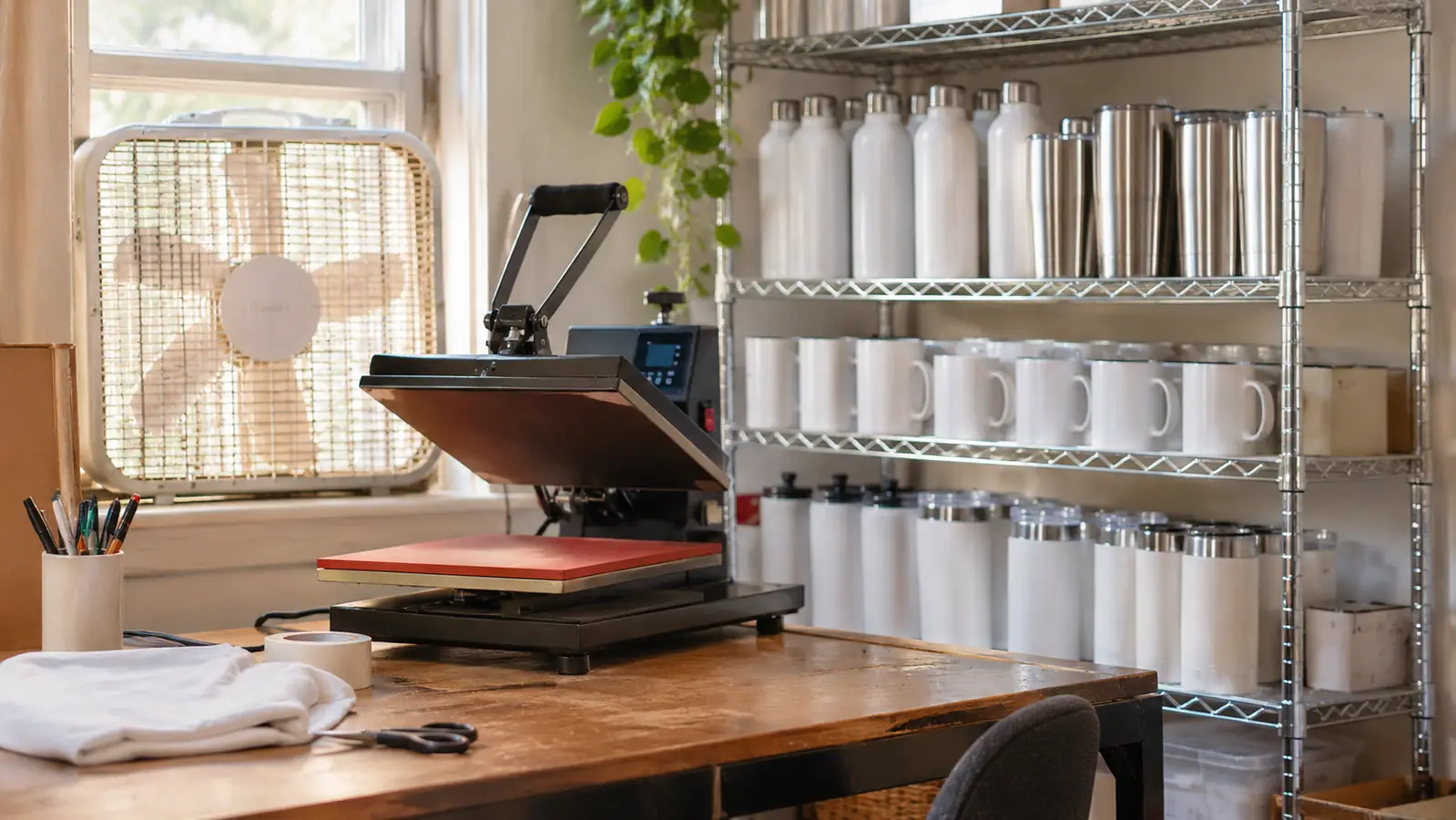
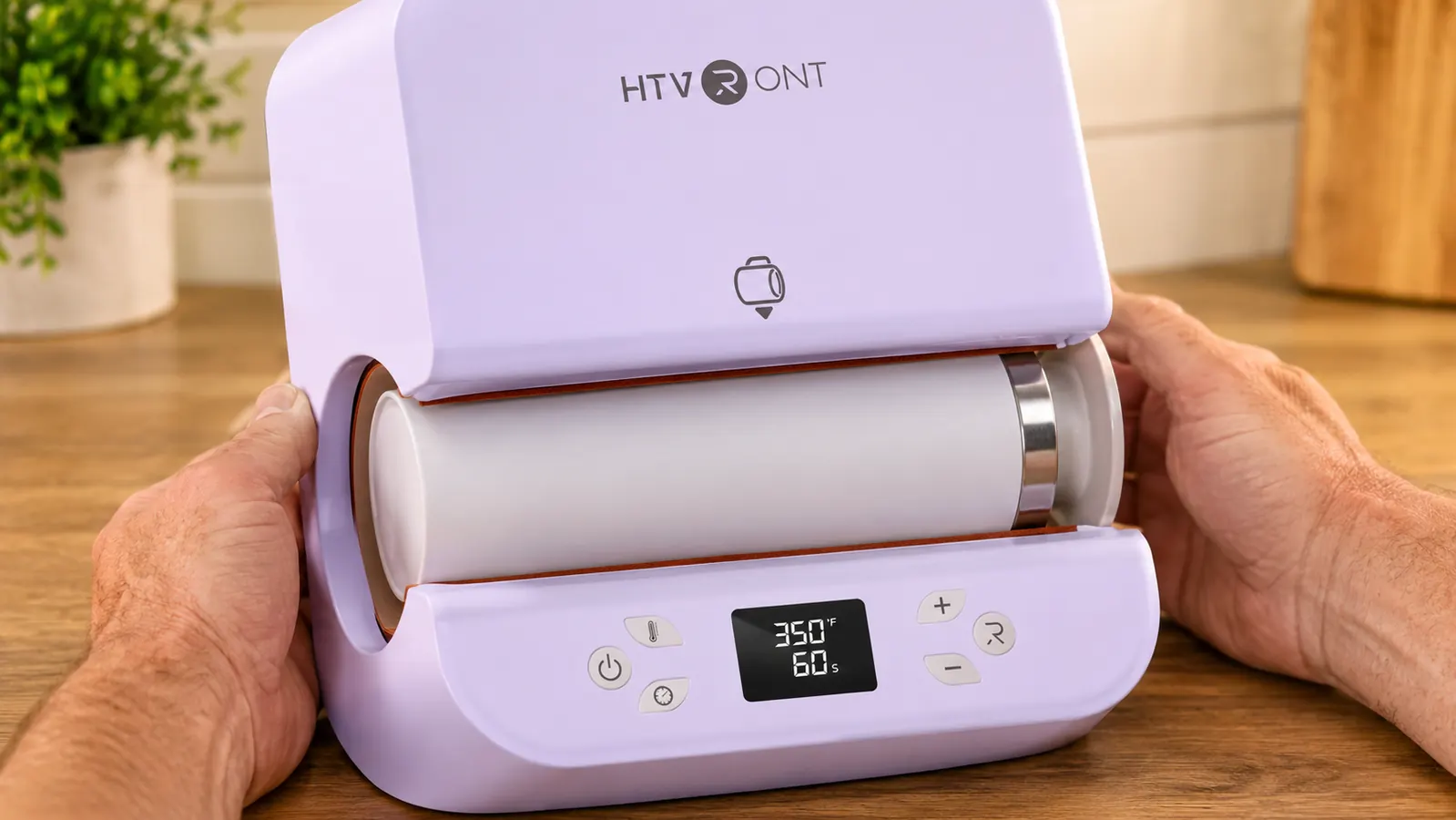
The machine measures 12.9 inches long, 10.9 inches wide and 6.3 inches tall, and it draws 600 watts on a standard 120 volt circuit. That footprint sits on my long folding table next to the converted Epson EcoTank without crowding it, which matters more than it sounds, because the table is also where I tape wraps and stack finished cups. I still run the window fan. The ABS shell gets warm in use and the room gets warm with it, so the fan stays.
The working window is drinkware from 2.9 inches to 3.2 inches in diameter, and from 280ml to 850ml, which is roughly 10 to 30 ounces. That covers nearly everything I get asked for. Teacher tumblers, the Little League team cups, the holiday mugs for the two teachers' groups. If a blank falls outside that window it does not fit, full stop, and I keep a cheap caliper in the drawer so I stop guessing.
I use that caliper more than I expected to. It sounds fussy until you have driven to the craft store for blanks that turned out to be 3.4 inches across the barrel and watched them not fit. That happened in February. I came home with a dozen matte blanks that measured a hair too wide, and they are still sitting on the wire shelf because I have not found a job for them and I am not going to force one. The low end is just as real. A small 10 ounce mug sits right at the bottom of the 280ml range and it does go in, but you feel the fit, and I set those aside for a Saturday when I am not doing anything else. The other habit I have is warming the machine before the first good job of the day rather than loading a cold press with a tumbler I care about. Ten minutes of nothing with a scrap blank in the pad, and then I start. It costs me a few minutes. It has saved me more cups than I can count.
The unit itself is 4.92 kg. That is not heavy in the abstract, and it is heavier than you want at ten at night when you are clearing the table so the room can go back to being a room. I leave it where it sits most weeks and work around it, which is the honest reason my folding table has not been a folding table since March.
Twenty-two tumblers went out with a pale seam. Four came back. That was the last order I ran without a press that holds its own pressure.
Where It Earns Its Space
Consistency across a batch is the whole thing. When I run twelve matching cups for a family reunion, they come out matching. Same pressure on cup one and cup twelve, because the pad applies it and I do not. Before this, I would pull the first three off the press and physically compare them under the kitchen light like a woman checking a dye lot. I do not do that anymore.
The second thing it buys you is your hands back. Once the press is closed and holding, I am free to trim the next order's transfers or write out a packing slip or answer a text from a neighbor asking whether I can do a mug by Friday. That sounds small. It is the difference between a two-hour evening and a four-hour evening, and I only have so many evenings.
The batch that convinced me was a Little League order in April. Twenty-four cups, all the same print, all going to kids who would set them down side by side in a dugout and notice. I ran them across two evenings after work, twelve a night, and I could not tell you which ones came off first without checking the numbering on my packing slip. That has never happened to me before. With the manual clamp I would have had four that looked like they were printed in different weather. Those evenings also taught me how the time actually goes. Load, close, work the next transfer while it holds, release with R, set the finished cup on the rack, load again. There is a rhythm to it, and once you find it the work stops feeling like a fight. Sal folded and bagged behind me and we were done by nine both nights instead of eleven. I keep a kitchen timer on the shelf for the hold, because I do not trust myself to watch a clock while I am trimming a transfer, and the one time I did trust myself I overcooked a cup by a full minute.
And it handles the awkward stuff better than I expected. The extended heating element reaches further down the barrel than my old clamp did, so the bottom third of a tumbler stops being the place where the print goes faint. That was the specific failure that sent four cups back to me in one week, and I have not seen it since.
The Flaws, Plainly
The diameter window is the real limitation and I want to be blunt about it. 2.9 to 3.2 inches and 10 to 30 ounces is generous until it is not. Slim can coolers, the wide-bottom stoneware mugs I get asked about twice a year, anything with a handle, none of that goes in here. This is a drinkware press with a specific shape in mind, not a universal one. If your product mix lives outside that window, this is the wrong machine and no amount of technique will save it.
The warranty is one year. I have not needed it, and I have read enough press-room stories to know that a year is a year. Buy it understanding that you are on your own after that, and treat the machine like something you want to keep running rather than something you want to push.
The press also does not fix a bad wrap. It presses what you hand it. If your transfer shifts a quarter inch while you are taping, you get a quarter inch of ghosting, and the machine will apply that mistake with beautiful, even pressure. Every re-do I have had since buying this has been my fault, not the press's, which is a less comfortable review to write and a more useful one. And before anybody asks, the press is not fast. It is not slower than my old method, but nobody should buy it expecting a tumble of cups in an hour. It is a patient machine and the patience is the point.
What I Liked
- Pressure stays the same from the first tumbler in a batch to the last
- The R button releases the heat pad instantly, which kills most ghosting
- Temperature range of 210°F to 390°F covers both sublimation coating and heat transfer vinyl
- Fits 10 to 30 oz drinkware from 2.9 to 3.2 inches in diameter
- 12.9 by 10.9 by 6.3 inches leaves room on a small work table
- Frees your hands mid-press so you can work the next order
Where It Falls Short
- Nothing outside the 2.9 to 3.2 inch diameter window will fit
- One year warranty, and support runs through the manufacturer
- 4.92 kg is a nuisance to move if your workspace doubles as a guest room
- 600 watts and a warm ABS shell mean the room heats up in a long session
- It presses whatever wrap you give it, bad tape line included
The Learning Curve Nobody Mentions
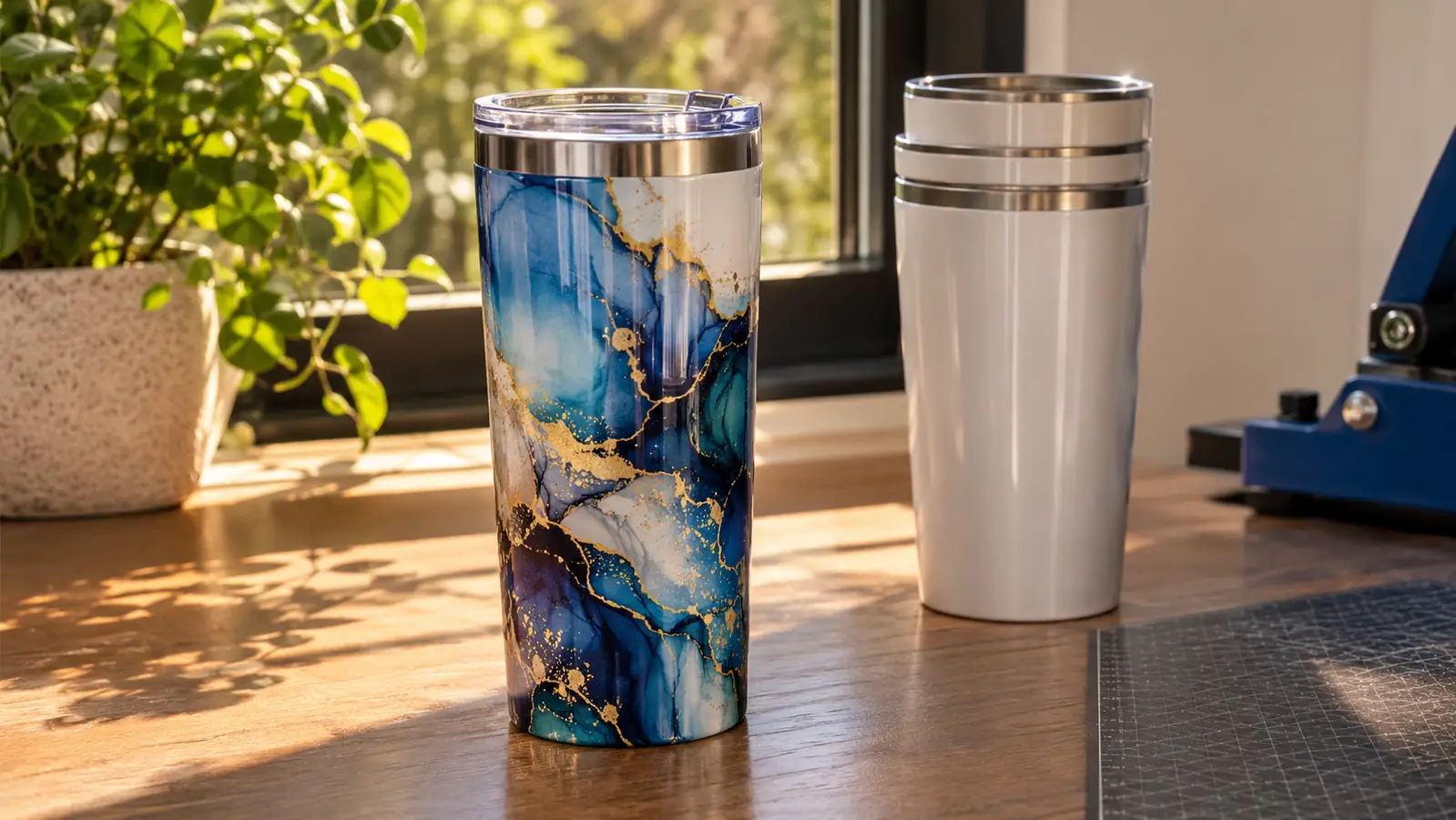
Nobody tells you that the temperature range is a range you have to learn, not a number you look up once. 210°F and 390°F are two very different afternoons. Coated sublimation blanks and a heat transfer vinyl job do not want the same setting, and the only way I found my numbers was ruining blanks I did not care about. Buy a five pack of cheap tumblers with the press and consider them tuition. Do not learn on the order.
My first real job with it was a set of coated blanks and I started near the top of the range because I assumed more heat meant more transfer. It does not. I got a scorched look at the edges and a print that looked like it had spent the afternoon in a car. I stepped the temperature down over the next two weeks, sacrificing one blank each time, until the coating stopped going chalky and the print came out dark and even. That process cost me maybe eight blanks and one Saturday. It would have cost me a customer if I had run it on an order instead. So the number you want lives in your blanks, not in a chart, and the only honest way to find it is to burn some cheap ones first.
Vinyl is a different afternoon entirely. A heat transfer vinyl job wants a lower setting than a coated sublimation blank, and the first time I ran one at my sublimation number I watched the carrier sheet start to curl and the edges of the letters lift before I got the pad open. I saved that shirt, barely, and I learned to check the setting twice. Now I keep two numbers on a sticky note on the shelf, one for coated blanks and one for vinyl, because I do not trust my memory at seven in the evening after a full day.
The other thing is that the press wants a clean, straight wrap and it will not forgive a lazy one. I tape the transfer down on all four edges now, every time, even when I am in a hurry, because the one time I did not I spent twenty minutes with a razor blade and a bad attitude. The machine rewards a careful setup and it punishes shortcuts with total consistency, which is somehow worse than a machine that fails at random.
Who This Is For
This is for the person running real orders out of a spare room, a garage or a corner of a shop, making 10 to 30 ounce tumblers and mugs in batches, who is tired of cups that match in spirit but not in print. If you have a shelf of blanks, a printer that only ever sees sublimation ink and a neighbor who keeps asking for one more, the HTVRONT earns its footprint. It also suits anybody who has been fighting a manual clamp and blaming themselves for pressure they cannot repeat.
Who Should Skip It
Skip it if your work is mostly flat goods. Shirts, totes and aprons want a flat press and this is not one. Skip it if you get asked for handled mugs, wide stoneware or slim cans, because the 2.9 to 3.2 inch window will send you back to a wrap and a hope. And skip it if you want a machine that does the whole job. This one removes the pressure variable. The wrap, the temperature and the tape line are still yours, and no press on the market will take them off your hands.
If you are taking orders, take them with a press that holds
Same pressure on the first cup and the twelfth, a 210°F to 390°F range, and an instant release that saves the print. It will not fix a bad wrap. It will stop costing you tumblers.
Amazon Check Today's Price on Amazon →