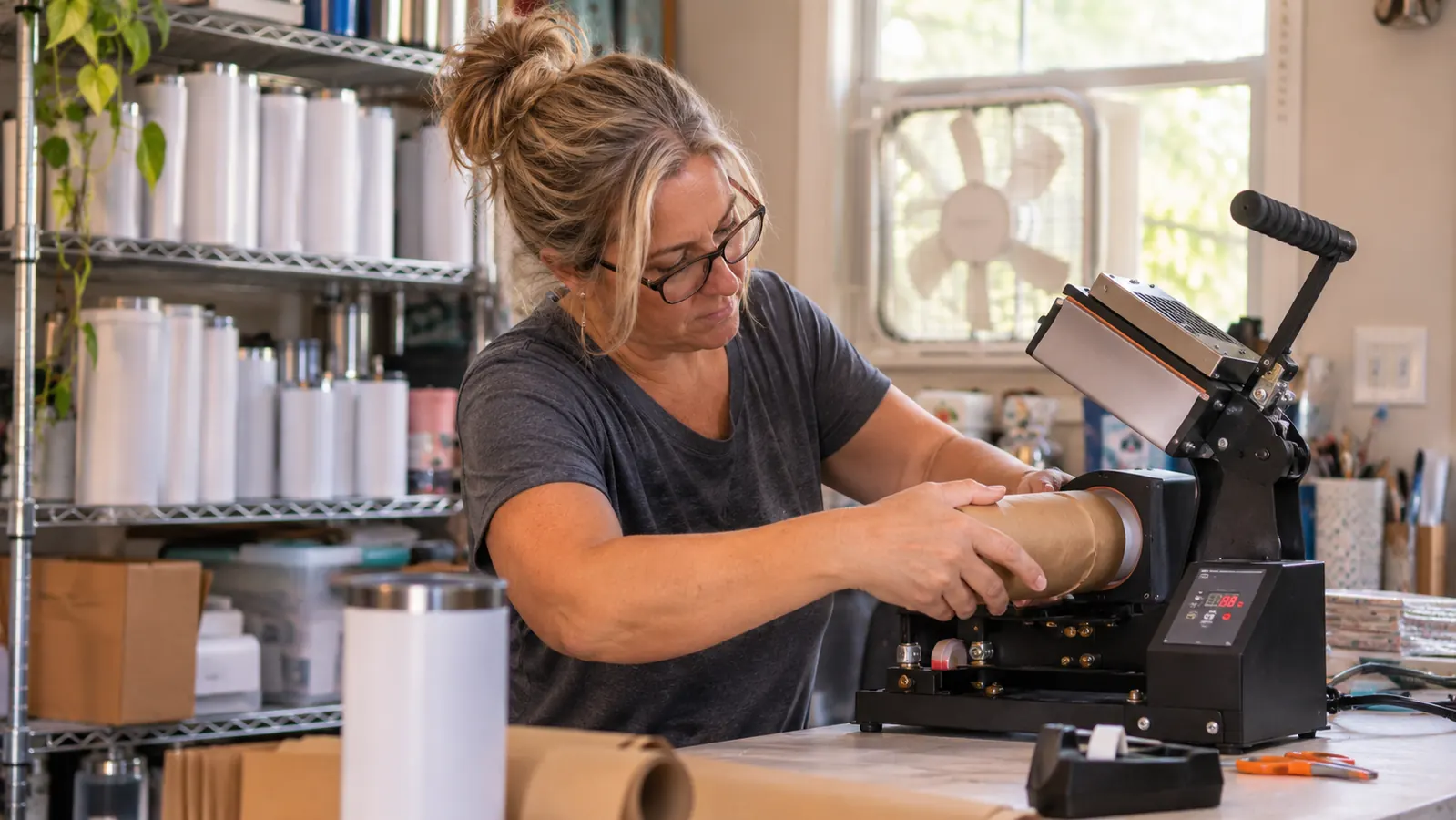
Two winters ago I ruined four tumblers in one evening. I wrapped each one in sublimation paper, taped it tight, and held it under a heat gun on my folding table, turning it like a rotisserie chicken and telling myself I had it under control. The wraps slipped. The designs ghosted. By the fourth one I had a drinkware piece carrying four faded copies of the same snowflake stacked on top of each other and a genuine question about whether I was cut out for this. What I needed was not more patience. What I needed was a machine that pressed the same way every single time. That is what the HTVRONT Auto Tumbler Heat Press turned out to be.
My press room is the spare bedroom in our house in Toms River, New Jersey. One long folding table, a wire shelf of blanks, a window fan that runs whenever the press is on. My husband Sal folds and bags the finished orders and volunteers as a test wearer whenever a shirt comes off the pad. My printer is one Epson EcoTank ET-2800, converted to sublimation, and it has never had anything but sublimation ink in it. No employees, no storefront, no second machine. So a tool has to earn its table space around here. This press takes about a foot of it, 12.9 inches long by 10.9 inches wide by 6.3 inches tall, and it has not moved since the week it arrived.
The Quick Verdict
Presses the same way on the first tumbler and the twentieth, which is the entire job. It does one at a time and it will not turn a spare bedroom into a factory.
Amazon Check Today's Price →The Machine That Ended My Ghosted Wraps
Same wrap, same shade, same result whether it is tumbler number one or tumbler number twenty four. It is the closest thing to a guarantee I have found in a spare bedroom.
Amazon Check Today's Price on Amazon →How I've Used It
The first real job I gave it was twenty four teacher tumblers for the two teachers' groups that order from me every August. Twenty four of them. In my heat gun days that would have been two weekends of misery and at least three redos, and I would have been up past midnight on the Sunday finishing the last four. This past August I started on a Tuesday evening instead, pressed six before the window fan had done anything useful, and had all twenty four wrapped and boxed by Thursday night. I did not lose a single one. With this press I set the temperature, seated the wrap against the heat pad, pressed the button, and walked away to trim the next wrap while the machine did the holding. That is the difference between this and every other method I tried. It holds the wrap against the drinkware for the full time without me standing over it, and it does not care whether I am paying attention.
It takes drinkware from 2.9 inches to 3.2 inches in diameter, and the listing puts the volume at 280 ml up to 850 ml, which it calls 10 to 30 ounces. That covers the 20 ounce tumblers I sell most, the 15 ounce mugs for holiday orders, and the 30 ounce bottles the Little League parents ask for at end of season. The ones that do not fit are the fat 32 ounce bottles and the skinny cans, and I say that up front to anyone ordering now instead of letting them find out the hard way. Turning away an order is unpleasant. Explaining why a customer's own bottle came back with a light patch on one side is worse.
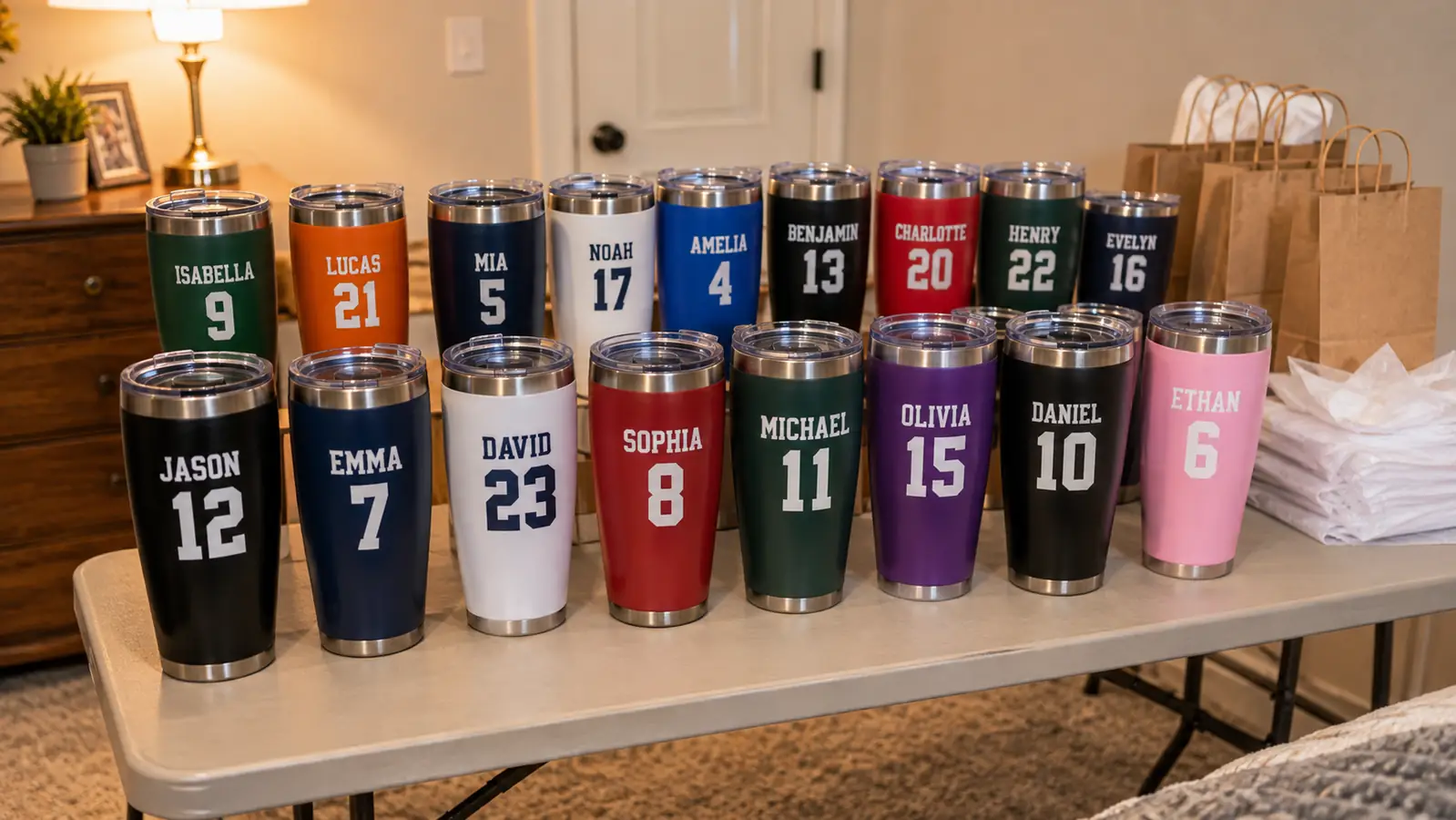
The order I am proudest of was the Little League end of season set: eighteen bottles, each with a different player's name and number, done over two evenings after work. Every one came off the pad with the name sitting square and the number matching the sample I pressed first. When you are pressing eighteen of something, sameness is the whole product. Nobody notices a great wrap. Everybody notices when the seventh one is a shade darker than the first, and that is the phone call that costs you the team next season.
What the Auto Press Actually Changes
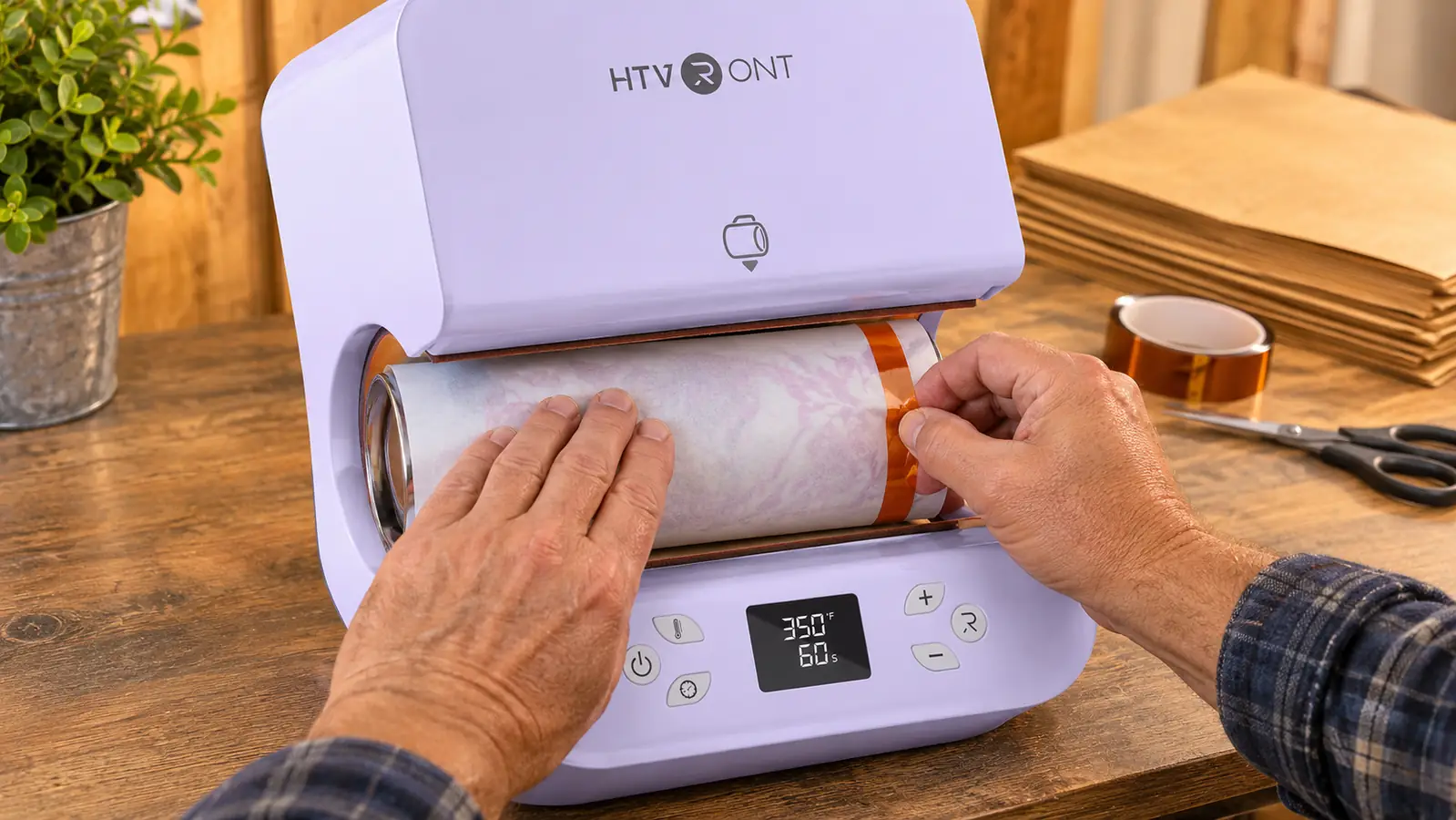
The part that matters is not a screen or a setting. It is the fact that you seat the tumbler against the heat pad, press the button once, and the machine handles the pressing instead of you clamping, unclamping, and second guessing. HTVRONT's listing describes it as no more manual or repetitive pressing, and after months of orders I would put it more plainly. It removes my hands from the part I was bad at.
The other thing I use constantly is the R button. Press it and the machine halts the heating and releases the heat pad instantly. That sounds like a small convenience until the first time you smell polyester starting to turn and you need the heat off that wrap right now, not after some cool down finishes. The first genuine save came in October, on a blend blank I had no business running at 390°F. I caught the smell maybe ten seconds in, hit the R button, and the pad let go of the wrap before the coating blistered. That piece is still on my shelf with a faint mark on one side and a lesson attached to it. The other two saves looked about the same, all of them on blanks I had misjudged rather than on the machine. I have also pressed it for pure paranoia a good many more times than three, and it behaves identically either way. There is no drama to it, which is exactly what you want at that moment.
Temperature runs from 210°F up to 390°F, and that range is useful rather than decorative. The cheaper coated blanks and the polyester blends want the lower end. The coatings I get from my usual supplier take the higher end and hold color better up there. I keep a notebook with the setting and the time for every blank I buy, because the press is consistent and I am the variable. Once I stopped guessing at time, my redo rate dropped more than any single piece of equipment ever moved it.
It pulls 600 watts on 120 volts. That matters in a spare bedroom more than it sounds, because my printer, the window fan, and a desk lamp are all on the same circuit and I have never tripped it once. The machine weighs 4.92 kg, a little under eleven pounds, so it lives where I put it and stays there. The housing is an ABS shell that wipes clean with a damp cloth when I get sublimation spray on it, and it is stated as a one year warranty.
The Numbers I Actually Care About
I keep count, because counting is how I know whether a tool deserved its space. In the months since it arrived I have run a little over 400 pieces through it. Twenty four teacher tumblers in August. Eighteen Little League bottles. Roughly sixty holiday mugs across November and December. The rest is the steady trickle of neighbor orders, birthday tumblers, teacher thank yous, and the small Etsy shop. The Saturday before Thanksgiving was the heaviest single day: fourteen mugs in one sitting, starting at seven in the morning and finishing a little after two, with Sal bagging as I went. That is the kind of run that used to break me, and it was honestly a little boring, which is the highest compliment I can pay a tool. Of those four hundred odd pieces, I have redone nine. Seven were my fault, wraps I taped crooked or paper I cut too short. Two were blanks whose coating was already suspect straight out of the box.
Nine redos out of four hundred is the number I would give anyone who asks whether this thing is worth the room it takes up. In my heat gun year I would have called nine out of forty a good batch. The press did not make me better at design, and it will not make anyone better at design. It made my bad days look like my good days, and in a business where people are paying for a name on a cup, consistency is the thing they are actually buying.
Nine redos out of four hundred pieces. In my heat gun year, nine out of forty was a good batch.
The Small Things That Matter After Month Three
The machine does not fix your wrap, and I learned that in week one for the cost of two tumblers. The paper has to be tight and taped on all four sides, and the seam where the paper overlaps will show if you let it sit crooked. What the press does is stop a good wrap from moving once you have it right. My redo rate fell from about one in four to roughly one in forty, and almost everything left over is taping, not pressing.
I keep a notebook, and it is the least interesting advice I can give and the most useful. Every new blank gets a page: what it is, the size, the temperature I used, the time, and whether the seam sat clean when it came off. Three months in, I have forty one pages and I no longer guess at anything. Page nineteen is a 20 ounce blank from a new supplier that came out flat and grey at my usual setting and wanted 365°F for a full minute instead. Page twenty two is that same blank done right. I still buy from that supplier, and page twenty two is the reason. A range of 210°F to 390°F is wide enough that guessing becomes a choice rather than a necessity, and I stopped choosing it.
Cleaning is a damp cloth on the shell and that is the entire routine. I do not let paper scraps build up under the heat pad, because a scrap pressed into a wrap leaves a mark you cannot unsee and a customer will find it. I also give the machine a breather between long runs, mostly because I need one too. Sal says the press has better stamina than either of us, and he is not wrong.
Where It Fights Me
It presses one tumbler at a time. That is the trade and I will not pretend otherwise. If you are doing thirty of the same mug, you are loading and unloading thirty times, and the machine does not mind but your evening does. I tape the next wrap while the current one presses, which gets me into a rhythm and saves real minutes. It is still one at a time. Anyone who tells you a single station press is a production line is selling something.
The diameter window is narrower than I expected. 2.9 to 3.2 inches is the whole of it, so anything chunky or tapered is off the table. The tapered tumblers I already owned press unevenly near the base, where the shape pulls away from the pad, and I stopped buying tapered blanks for good after the third try. The 30 ounce ceiling means the oversized bottles people bring me from their own kitchens get a polite no and a recommendation to someone with different equipment. That is not my favorite conversation to have, but it is honest.
There is also a learning curve that has nothing to do with the machine. Every new blank I bring in behaves differently, and the first one of a new style is usually a test piece I press for myself and keep. If you are the kind of person who wants to load a cup, hit a button, and trust that it will be right on an unfamiliar blank, this press will teach you patience whether you asked for the lesson or not.
What I Liked
- The same result on tumbler one and tumbler twenty four, which is the entire reason I bought it
- The R button halts the heating and releases the heat pad instantly, and it has saved three wraps for me
- A 210°F to 390°F range that genuinely covers both cheap coated blanks and the better ones
- 600 watts on 120 volts, alongside my printer and fan on one spare bedroom circuit, with no tripped breaker
- Takes up roughly a foot of table at 12.9 by 10.9 by 6.3 inches, and the ABS shell wipes clean in seconds
- A stated one year warranty, with the support contact sitting right in the listing
Where It Falls Short
- One tumbler at a time, so thirty mugs means thirty load and unload cycles
- Diameter is limited to 2.9 to 3.2 inches, which rules out fat bottles and tapered blanks
- The 30 ounce ceiling turns away some drinkware customers bring in themselves
- You still have to learn the right temperature and time for every new blank you buy
Who This Is For
This is for someone who already has a sublimation printer and a table, who works evenings and Saturdays, and who is tired of a wrap shifting under a heat gun halfway through. If you are pressing ten to fifty drinkware pieces a month and the last one has to look like the first, the HTVRONT does that job without fuss and without asking you to stand over it. It is also for the person who hand wrapped an order, had three pieces come out a shade off, and lost the customer over it. That is the mistake this machine prevents, and it is a cheaper lesson than the one I learned with a heat gun.
Who Should Skip It
If you are pressing thirty identical mugs for a corporate account every week, one station will bottleneck you and you should be pricing multi station equipment instead of talking yourself into this. If your blanks are tapered, oversized, or already sitting in your kitchen cabinets and you cannot change that, the 2.9 to 3.2 inch window will fight you on every order. And if you have not started yet, understand that no press fixes a design that is not ready or a coating that will not take ink. Buy the printer, learn one blank, sell ten cups. Then come back and look at this.
Four Hundred Pieces In, I Would Buy It Again
One tumbler at a time, the same result every time, and a spare bedroom table I can still find underneath it. That was all I ever wanted from it.
Amazon Check Today's Price on Amazon →